



How Health Insurers Are Using FinTech to Cut Costs

For health insurers, business doesn’t come cheap, which was especially problematic when the industry faced the Covid-19 pandemic. Insurers had to continue funding treatments, tests, and other care services. Adding on to this, there was significant revenue loss without the ability to perform surgeries or offer the other bulk of their services. One example is major American health care provider Humana which saw a loss of nearly $460 million in 2020

This was a significant dip from 2019 when the company saw profits of just over $590 million. The fluctuation was due in part to the influx of hospital patients being treated for Covid-19 which lowered the utilization of other care resources by 15%. Not to mention that these companies had to terminate employees and accommodate/navigate a hybrid work environment in the midst of all this.

Making Necessary Changes

The shift made companies realize that they’d have to pivot to keep up with their industry's changes. These changes specifically needed to be focused on administration in areas such as communication and payment methods. This is where FinTech technology came into play; by shifting to electronic payments and digitally corresponding communications between members and providers, the industry was able to cut costs and retain members. 

Insurance companies recognized that digital transformation is necessary to keep up with consumer demands. The particular technology that revolutionized the insurance industry is primarily made possible through ​​the Automated Clearing House network and Virtual Credit Card (ACH/VCC) which eliminate paper records and reduce customer service requests. In effect, this is attractive for members as well as companies who have benefitted from reduced support costs.

At this point the message is clear: a digital landscape allows providers to focus their efforts on the competencies that make their services useful. Though this was inhibited by the constraints of the pandemic, it may have been the cold awakening businesses needed to scale through the next decade. Insurance is a highly competitive market and although the service is not mandated everywhere, it is something that people need and will look in-depth for the best option.

The insurance industry is moving quickly, and again, there will always be a need for this service, but providers need to roll their sleeves up to bring the best product. With advancements like InsurTech, AI, ML, IoT, and other software tools like them, health insurers can operate cheaper and far more efficiently. Here are some examples of how technology is likely to change the industry:

  • Customized Options: Product manufacturers and distributors teaming up to embed insurance within products and services (IoT) would allow consumers to find options that support their specific lifestyles.

  • Product Flexibility: Coverage that accommodates specific needs for one's lifestyle, wellness, or current life stage and that is event-driven, time-flexible, adjustable, and modular. It is likely we could see a dominance in technology that takes this data into account when developing coverage plans.

  • Automated Underwriting: AI and technological algorithms individualize pricing options based on the risk that potential customers carry.

  • EZ Value Options: Taking into account the shopping habits of consumers in new markets, those who offer products that are flexible in terms of timeline, and who do not lose sight of underwriting (to weigh risk) will be successful in this market. 

AI and the machines in its technological hemisphere are changing the insurance industry from underwriting to distribution to pricing and claims. After seeing the beneficial changes InsurTech brought to the industry, companies are using these outlined methods among others to make their operation run effectively for themselves and their clients. 

This technology puts consumers in the driver's seat of their healthcare and well-being. For companies, this makes the sales process easier as they can understand their clients better. It’s made connecting with consumers easier which led to over $2.7 billion generated in revenue for the insurance industry during 2021 using AI. That number is expected to reach around $46 billion in the next decade.

Reasons Behind the Growth

Insurance companies continually investing in AI and Machine Learning dramatically increases collaboration between solution companies and insurers. Additionally, insurance services looking for personalized solutions contribute significantly to the global expansion of the solutions development market. 

Common worries about limits on the market stem from high usage costs and talent shortage. However, this risk is mitigated with initiatives from the government and surging investments which make the market highly lucrative and sustainable long term. 

The Takeaway

Finding solutions that serve the best interests of your business is not an inducement but a requirement for a software company to earn business. The technology serving the FinTech industry isn’t exclusive and this is something insurers have tapped into. We can expect to see other industries following the same embracement of AI & Machine Learning so long as the right solutions are there to serve them.

Written By Ben Brown

ISU Corp is an award winning software development company, with over 17 years of experience in multiple industries, providing cost effective custom software development, technology management, and IT outsourcing.

Our unique owners mindset reduces development costs and fast-tracks timelines. We help craft the specifications of your project based on your company's needs, to produce the best ROI. Find out why startups, all the way to fortune 500 companies like General Electric, Heinz, and many others have trusted us with their projects. Contact us here.




Why Hire a Software Development Company in Canada?

Next to a giant like the United States, Canada can often get lost in the background thanks to its smaller population and unassuming reputation. However, there’s a lot to be said about the potential goldmine Canada has to offer, especially in terms of tech talent.

Software development is a crucial aspect of any business that wants to stand a chance in today’s world. There are countless processes in any given company that can benefit from being automated.

Hiring within North America can be very expensive—if you don’t know where to look. Some benefits to hiring a software development company in Canada include:

Talent

A group of engineers working together.

Curious about what Canadian tech talent can bring to the table?

Growth

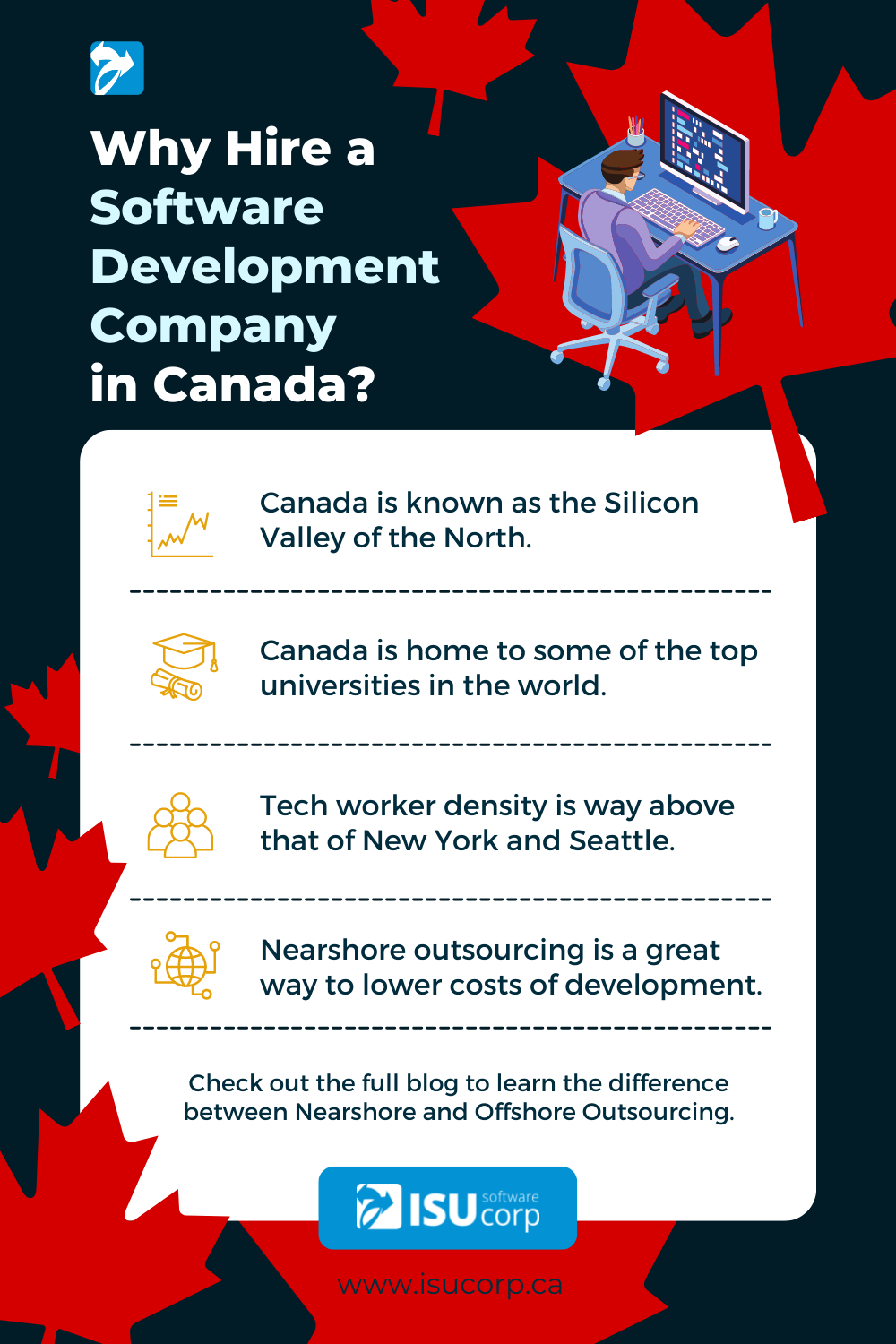
Canada is known as the Silicon Valley of the North. Thanks to its rapidly growing tech sector still being somewhat untapped, businesses have the opportunity to utilize top talent at a relatively cheaper cost while remaining within North America.

Education

Canada is home to some of the top universities in the world. Canada is constantly building up highly-talented tech workers, and it shows: “The Toronto-Waterloo corridor is the largest tech cluster in North America outside of Silicon Valley.” It’s crucial not to overlook the huge pool of talent waiting just North of the United States. This corridor is also recognized as the #1 Startup, Cleantech, and Fintech ecosystems in Canada.

Skill

The expertise within a Canadian software development company is guaranteed to deliver beyond the expectation. Software companies grown in the environment of a newer Silicon Valley is shaped to take software solutions to the next level. It’s no coincidence that our tech scene is booming with a tech worker density comparable to Silicon Valley, and way above that of New York and Seattle. According to the Waterloo Economic Development Agency, the Toronto-Waterloo corridor is home to 15,000 tech companies, including 5,000+ startups, and more than 300,000 employees in high-tech industries.

Next-level Outsourcing

Nearshore outsourcing is a great way to continue to lower costs of software projects. A Canadian software company that prioritizes training outsourced talent to the same standard brings all the benefits of homegrown skilled workers to the forefront of any project.

Time Zone

Man working on laptop checking his watch.

When looking for software solutions, it’s tempting to outsource to countries like India, China, or the Philippines. There are many talented engineers outside of the continent ready to work, and while the world has largely moved to working entirely online, there are still too many negatives when it comes to outsourcing so far away.

Offshore Cons

The biggest setback, of course, is the massive differences in time zone. When you have teams that are anywhere from six to twelve hours off from your local team, it can wreak havoc on your projects. This can cause issues and delays, as communications break down easily and time is lost to waiting on days-late responses. Too much time is lost trying to wait or accommodate to offshore teams.

Language barriers can also be an unfortunate setback. When outlining the needs of a software solution, there can be no room for misunderstandings, lest there be more delays and missed deadlines.

Nearshore Pros

When hiring local or nearshore, work is efficient thanks to a shared eight-hour workday. Building a software solution is highly collaborative in nature; any successful project demands a fast-paced and responsive communication approach, which is made simpler when working with engineers in your time zone.

Culture

A group of four friends embracing in an open field.

Canadians have a reputation for being really nice. While there’s debate on how true the stereotype is, it’s true that Canadians tend to be more altruistic when compared to their American neighbours. Isn’t that ideal when working on something as important as the backbone of your business?

Canadian talent also offers a wide worldview, as the immigration system allows for people from across the globe to gather in one place and collaborate on shared goals. The diversity and openness of Canadian culture encourages the melding of ideas, leading to unprecedented creativity and innovation.

This also creates opportunity for empathy, an important element to working with any software development company. It’s crucial to work with a team that truly understands the ins and outs of your business, while also seeing beyond the verbalized wants and into the needs of any software solutions.

ISU Corp calls this practice the Owner’s Mindset. Our teams are trained to see beyond the specifications of a project to cover all of a clients’ bases. Our experts are ready to analyze a businesses’ needs and deliver software tailored to suit its needs.

The Takeaway

Hiring a software development company in Canada is a strong choice for any business to make. Canada is home to globally reputable universities, which means a constant stream of new, highly-talented engineers, tech workers, and entrepreneurs. Canada’s technology sector is growing exponentially, and with this comes the opportunity for businesses to hire skilled software development companies at prices well below their American counterparts, while still upholding a level of standard that can only be brought from teams in North America. Consider working with ISU Corp, a world-class software development company that participated in the creation of Canada’s Silicon Valley. You can learn more how ISU Corp can add massive value to your business by watching this 2 minute video here.

ISU Corp is an award winning software development company, with over 17 years of experience in multiple industries, providing cost effective custom software development, technology management, and outsourcing. Our unique owner’s mindset reduces development costs and fast-tracks timelines up to 70%. We help craft the specifications of your project based on your company's needs to produce the best ROI. Find out why startups, all the way to fortune 500 companies like General Electric, Heinz, and many others have trusted us with their projects. Talk to us.

Written By Natalie Mansilla

ISU Corp is an award winning software development company, with over 17 years of experience in multiple industries, providing cost effective custom software development, technology management, and IT outsourcing.

Our unique owners mindset reduces development costs and fast-tracks timelines. We help craft the specifications of your project based on your company's needs, to produce the best ROI. Find out why startups, all the way to fortune 500 companies like General Electric, Heinz, and many others have trusted us with their projects.  Contact us here.



Learning to Code For Beginners: Tips From Professional Software Developers

When you hear the term “coding,” you likely correlate it to an image of a programmer with headphones on in a dark room typing their fingers to the bone. To someone who isn’t familiar with the process, this may make coding seem like a robotic task consisting of nothing but numbers and letters. There’s a lot more to it than typing colourful lines on a black screen; the process itself is not for the fainthearted. Everyone interested in technology should at least have an understanding of coding, especially as society moves to a dominantly digital consumer landscape. 

Coding in its most basic form can be defined as people communicating with and teaching computers how to function. When a developer goes into the system, they use code to instruct what actions the computer and other relevant hardware must perform. The apps, websites, and technology you use daily are brought to life through coding languages and frameworks. As technology becomes more relevant in people's everyday lives, the need for programmers grows.

Today, over 50% of jobs require skills in technology which has placed coding in high demand among those skills. We expect that number to reach nearly 80% in the next decade. This will trigger the vast majority of businesses to rethink their digital landscape and search for talent that is keeping up with/exceeding the demands of today.

So now that we’ve established what coding is, let's go into the specifics of what it takes to adopt the practice as a complete beginner:

Mindset

Coding is a problem-solving task that not only challenges but requires you to use critical and logical thinking. You have to see problems from a different perspective and then break that problem down into digestible tasks (Examples: Make a flowchart or divide it into sub-problems). In forming those tasks, the programmer is observing the situation and uses their knowledge of languages and frameworks to find a solution for each. 

The code you're writing is meant to serve a purpose, this purpose needs to be in the front of your mind the whole time so you understand not only what you're doing but why you’re doing it. This will mean keeping a calm and collected attitude as you navigate the programming process. Essentially, coders need to understand that every problem has a solution and they have to do whatever it takes to find it.

Learn one language

To understand coding, it will be useful to master one coding language to the best of your ability. Some examples would typically be Java, Python, C, or Ruby as your best starting points. Aside from being among the most commonly used, they are easy to learn. Once you know one language, there will be carry-over concepts and knowledge that will make it easy to learn others. Additionally, it’s best to have one language that you’re more proficient with as your go-to since you’ll likely use it often.

Coding doesn’t require you to be a genius computer scientist. If you are a serial problem-solver, then you can learn the rest. One tool that will be a great resource is Harvard University’s free introductory to computer science course (CS50) that all first-year computer science students take. In this course, they teach you the basics of coding such as Algorithms, Data Structures, CSS, Python, JavaScript, and more. As you learn the fundamentals, you’ll move to execution, leading us to the next point.

Identify the purpose of your coding

When you build an understanding of coding principles and feel ready to put them into action, the next step is identifying your “why”. What needs are your solutions going to fill? We use coding to find ways of bringing concepts to life. Who in the 1970s would’ve thought you could send a text or FaceTime someone? These big changes in technology start with small advancements which will be a beginner's best friend.

Start coding something small such as crafting a simple message like “what is your name?” There are numerous methods to do even this specific task such as reverse alphabet letter correlation, manipulating the orientation of letters, or even using symbols to represent letters.

When one has built a solid understanding of software methodology and embraced a coder's mindset, one will see these simple tasks in different ways. It starts with an idea that becomes a vision. Essentially, when coding, you want to identify and try to solve your problem before you begin using algorithms. Seeing the solution and having it clear in your mind will stick with you as you find ways to fill in the gaps. 

Get your hands dirty

Branching off of the last point, no experience will compare to what a great team can teach you. The coding community is very welcoming and will not refrain from sharing their knowledge and advice with a beginner. As you network within the settings where you are learning, find out if there are hackathons you can participate in. A hackathon is a big coding project crammed typically into a 24-hour window. Beginner-friendly hackathon events use basic coding languages which would be a great learning experience. 

In addition to building a network and becoming active as a developer, it will be helpful to look into pair coding. This concept is rather self-explanatory as it is two programmers at one computer. There is the old saying “two minds are better than one” which is relevant in software development teams and why they use pair programming as an agile technique. But in a strictly learning-oriented manner, you will learn more from others than from tutorials or books. 

Challenges to expect

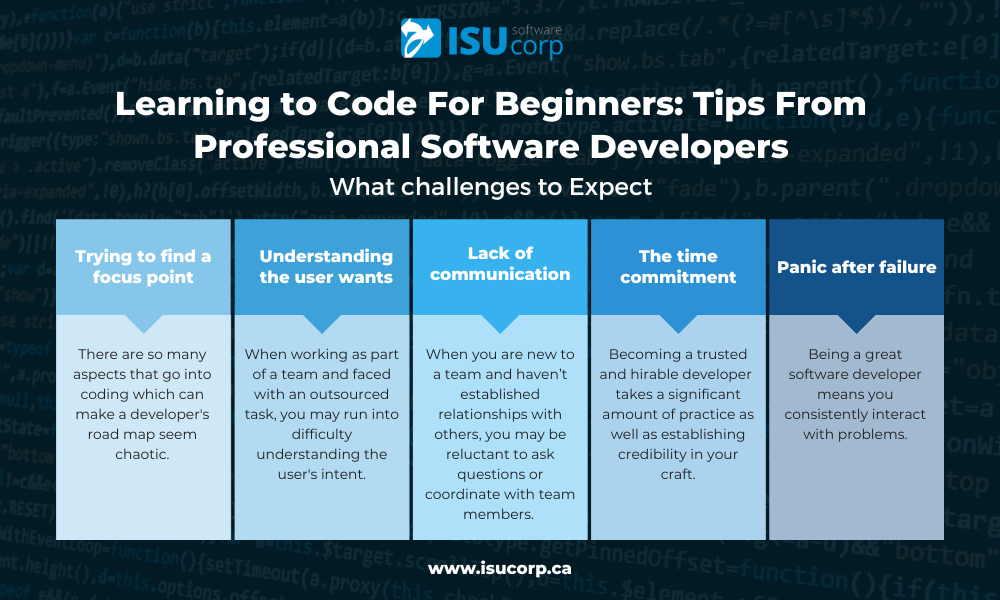
Now, while this section has depicted learning to code as a bed of roses, there are several challenges you can expect to encounter on your journey. In this section, we’ve outlined 5 key areas to look out for:

  • Not knowing what to focus on: There are so many aspects that go into coding which can make a developer's road map seem chaotic. As a beginner, this can be overwhelming and, in some cases, discouraging. However, a key characteristic of a good programmer is acknowledging and accepting that there is a lot you have to do to succeed. 

  • Can’t understand what the user wants: When working as part of a team and faced with an outsourced task, you may run into difficulty understanding the user's intent. Programmers specifically run into this issue since they are not typically the ones sitting down with the client. Project managers make it less stressful to update software with scrum/agile approaches. However, this can only get you so far as a programmer when there is minimal interaction with the end user.

  • Lack of communication: When you’re newly working as part of a team and haven’t established relationships with others, you may be reluctant to ask questions or coordinate with team members. When working in IT, this can be a significant downfall since communication needs to be a consistent force within the team.

  • The time it takes: Becoming a developer that someone would want to hire (whether as part of a team or to handle an outsourced project) takes a significant amount of practice as well as establishing credibility in your craft. Everyone wants the shortcut, but just like anything worthwhile, coding takes time. You can’t learn these concepts in a week. Beginners need to understand the information and see it in action while acknowledging that there will be failures in the process.

  • Panic after failure: Being a great software developer means you consistently interact with problems. As you implement your attempt to solve these problems, you will not have a 100% success rate, which means things will go wrong. Finding out what went wrong is called “debugging” which is a process that scans for errors to determine their cause. Though sometimes it can be hard to admit mistakes, having this form of debriefing will make you better. Instead of letting emotions get in the way, finding the source of what went wrong and learning from that will be much more valuable.

The Takeaway

At the root of all these challenges and the learning processes remain the focal point of having the will to not only succeed but use technology to create an experience. Google wouldn’t be the platform we utilize every day without its codebase, and even that started out as a concept. If you take your time to learn the fundamentals, you will have this as a competitive advantage when working with technology.

Written By Ben Brown

ISU Corp is an award winning software development company, with over 17 years of experience in multiple industries, providing cost effective custom software development, technology management, and IT outsourcing.

Our unique owners mindset reduces development costs and fast-tracks timelines. We help craft the specifications of your project based on your company's needs, to produce the best ROI. Find out why startups, all the way to fortune 500 companies like General Electric, Heinz, and many others have trusted us with their projects. Contact us here.