


How to Build Software With an End-User Mindset

Software development is a solution or an answer to the needs of a technical environment. This can be something as large and complicated as an app with millions of users or as simple as a small-scale e-commerce store. What’s important to note is that these solutions are not for the development team's satisfaction, but rather for the parties who’ve brought their issues to be solved by the development team. Sounds like common sense right? Yes, we understand this concept to be true but it is not always at the forefront of a development team's project roadmap. 

Any software developer can piece together an idea and materialize it in an application. However, for that application to succeed, there needs to be sufficient research, communication with the customer, and testing. In this section, we will be going over how development teams can enforce what’s known as an “end-user mindset” through their development process. 

What is an “end-user” mindset?

The concept is quite simple, but that doesn’t make the execution aspect easy. An end-user mindset is implemented by aligning the development process with the needs of your target audience in mind. This means that consistent improvement, data-driven development, and customer satisfaction remain at the front of all team members' concerns. 

Why is it important?

The reason there is any need to emphasize this approach is that developers commonly release the minimum standard features that check the boxes of the job description but don’t take into account the long-term success of their customers. This isn’t necessarily intentional as there can be issues in communication between developers and the sales team arranging the deadline or the team might simply be unable to identify bugs in their code.

The possible issues are a long list; some can be mitigated with scrum/agile methodologies, but it doesn’t make the product bulletproof or replace the value of tending to the end-user's needs. Even during testing phases, every possible contingency cannot be recognized and tested, which always leaves that risk on the table.

Consider that technology and data are fairly new factors in decision making but they’ve established themselves as pillars of the process. Most businesses today know that technology is a make-or-break factor for the team's success. This makes business in the tech sector extremely volatile. The United States alone is home to nearly 50,000 tech startups, most of which will not survive their first 5-10 years in business. This is the most competitive market in the world, and differentiating your business from the competition with an end-user mindset might be a contributor to your success. 

Here are some tactics to set your organization off on the right foot:

User-centred design (UCD)

User-centred design is a byproduct of user-focused development methodology. This approach follows guidelines that are formed based on analysis from interactions with the end-user. For example, this includes prioritizing touch bases, identifying requirements, and overall observance of the behaviours of the audience throughout the software development process.

Essentially, UCD is meant to throw out the client's old playbook and implement new software solutions as opposed to adding optimization features to the original system. The best software developers will take feedback into account and use it as inspiration for the changes they make to development features. The idea is that consistent communication with your end-user means you’ll know what they want and how they want it. Once that is established, you can build a product that addresses all concerns and will support the application's long-term functionality.

Test the product’s viability

Before full-blown software development is implemented, it will be wise to undergo tests that ensure what you’re building is something people want. A concept can seem like a great idea when you map it out, but nothing will tell the truth like the reaction of the market.

Cost-effective testing: Testing software doesn’t need to be done on a large scale audience. An effective method could be to gather several people and observe how they react and interact with various features of an application. Additionally, simply asking consumers their areas of concern with the system (previous or prototype) and what aspects they like are great for constructing a product that the market wants.

Identify requirements

Basing a product around the desires of your market requires you to compile a report of your product's goals, the overall vision, scope, cost, and timeline. The purpose of this is again, to make sure all necessary features are built into the product without having to go back and change too much. 

When this aspect is neglected, it leads to communication issues, an unorganized workflow, and an overall lack of cohesion which will result in a poor final result. 

Strategically improving the product

New factors (both external and internal) are going to present themselves in the market as well as in your organization. Most companies have a clear vision of how they want their product to look and operate overall but still fall short by neglecting a plan for consistent innovation. Consider some of the social media platforms you or people you know use daily. Notice that there are constant updates to the look and feel of the platform, some of which stay, and others improved on. Who inspires these changes? 

Well, notice the recent trend of platforms adopting TikTok's approach to content delivery (Instagram reels, Snapchat Spotlight, or YouTube shorts). These changes are made from observations in the market. Likely two questions need to be answered when a platform makes strategic changes; What does our audience like? How can we make it our own?

TikTok’s delivery of content is a good example because it demonstrates how platforms notice what keeps users engaged. When platforms saw TikTok’s usage rate blow past theirs, they implemented their approach to even the playing field. 

This concept is the same with any business and it is why software development is so relevant to keep up with ever-changing markets. 

Build scalable software

Branching off the last point, to keep up with changes not only in the market but with your company's digital Infrastructure requires software that can manage the load. Without scalability, companies will run into issues facing downtime, maintenance, and even possible security breaches.

When you start the development process with scalability as a priority, you’re giving your brand the upper hand with benefits such as reduced cost of maintenance, unique user experience, and faster functioning. Every enterprise software will require scalability to meet the demands of the organization.

The Takeaway

Every product is created based on a concept meant to either help a specific niche or change something for everyone. Companies like Apple or Tesla have a vision of everyone using their products, whereas a gaming company or a women's clothing e-commerce store would cater to a specific audience. Whichever side you’re on, an end-user mindset is where the most powerful inspiration comes from. 

Written By Ben Brown

ISU Corp is an award winning software development company, with over 17 years of experience in multiple industries, providing cost effective custom software development, technology management, and IT outsourcing.

Our unique owners mindset reduces development costs and fast-tracks timelines. We help craft the specifications of your project based on your company's needs, to produce the best ROI. Find out why startups, all the way to fortune 500 companies like General Electric, Heinz, and many others have trusted us with their projects. Contact us here.



Top 7 Custom Software Development Companies in Canada

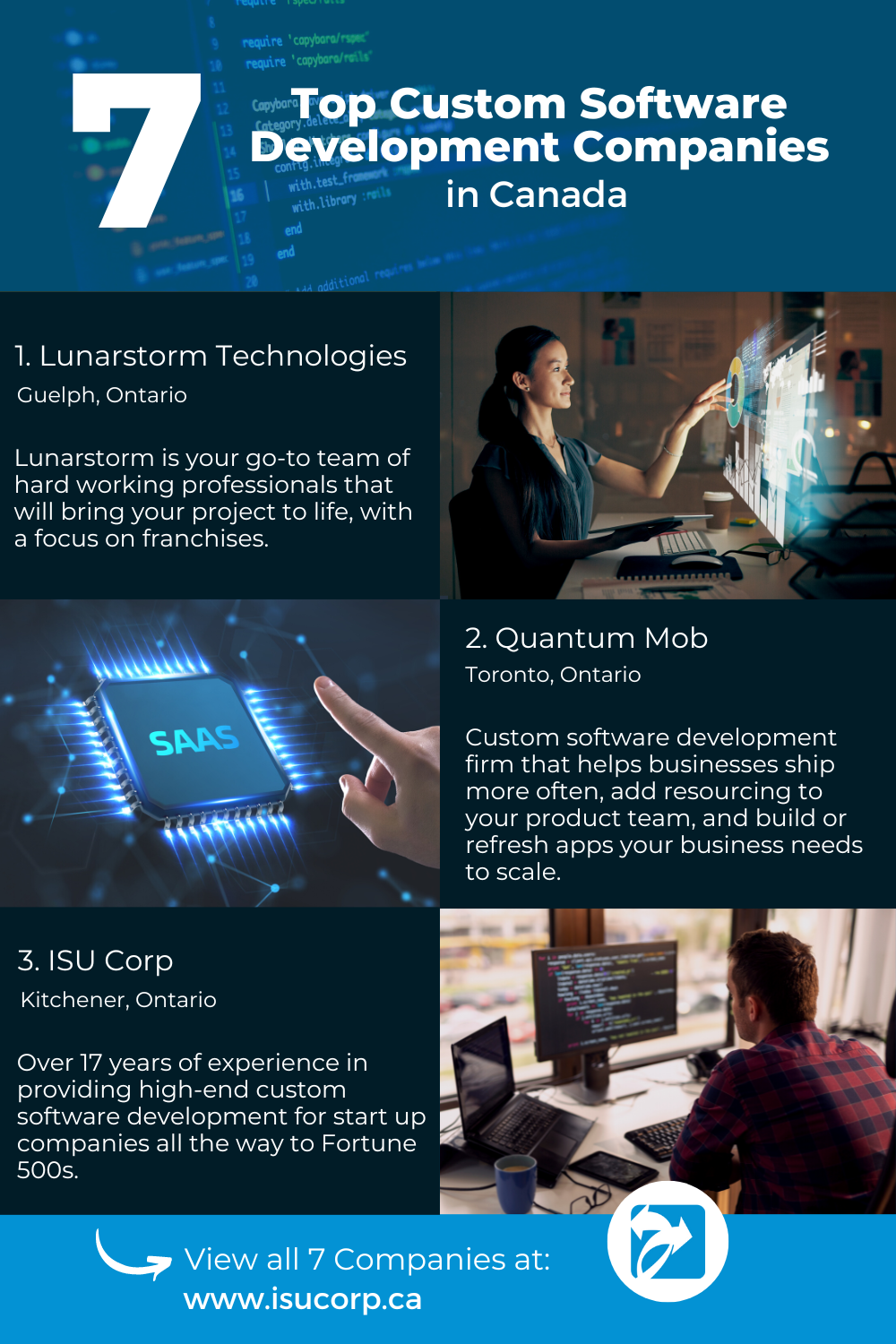
Choosing a software development company to work with can seem like a daunting task. There’s an array of great choices out there, but we’ve narrowed it down to the top seven companies that could be the best choice for you. These are all Canadian companies that offer the best of the best, and we’ve amalgamated the highlights of each for you to choose whoever best suits your company’s needs.

 If you’re wondering why we chose specifically Canadian software companies, here’s a list of good reasons as to why it’s in your best interest to hire in Canada. 

This list is in no particular order. Each company offers something unique to the game, and they all offer pros to consider. Without further ado, let’s dive in.

  1. Lunarstorm Technologies 

In business for over two decades, Lunarstorm is your go-to team of hard working professionals that will bring your project to life. Working with individual-sized businesses to companies with over 350 stores nationwide, Lunarstorm has the experience you need.

With clients ranging from the University of Guelph to OK Tire, Lunarstorm specializes in IT support, software development, web design and SEO. If you’re looking to create a beautiful website that ranks on Google’s search engine results page, Lunarstorm has the talent to back you up.

2. Quantum Mob 

Quantum Mob is a custom software development firm that helps businesses ship more often, add resourcing to your product team, and build or refresh apps your business needs to scale. Based in Toronto, QM specializes in creating beautiful and functional products that deliver results, especially for loyalty programs and user-end applications. Their clients include Aeroplan, Air Miles, and AMD. If you’ve got similar projects, Quantum Mob is sure to help you kickstart your plans by helping you identify the problems in your business.

3. ISU Corp

Located in the technology triangle, ISU Corp has over 17 years of experience in providing high-end custom software development for companies like General Electric, Labstat, the University of Waterloo, and the Ontario Teachers Insurance Plan. From crafting specifications to providing top developers in your time zone, ISU Corp has completed thousands of projects making technology as it should be: simple. 

Trusted by start-ups, midsize and Fortune 500 companies, ISU Corp is the industry leader for innovation. Their new product, the ISU Core, is a time and money-saving platform that already comes with common features pre-built and ready to customize to your company’s branding. This can help save you up to 70% of implementation costs, all while giving you the software to scale your business in record time. 

ISU Corp is an excellent choice if you’re look fore a Custom Software Development Company in Canada

4. Duck Labs

Duck Labs delivers practical solutions to difficult business problems, leveraging technology in ways your customers will love. They focus on “design-led development”, which means that throughout the development process, they are keeping your customers’ experience in mind. Their commitment to user-centred innovation means the users point of view is represented throughout the project: their goals, tasks, pain points, and needs; business strategies and requirements; and the technological suitability and benefits. If you are customer-oriented, then Duck Labs is the way to go.

5. Spaceo 

Looking for a custom Android app development solution? Spaceo has been recognized as one of the most trusted Android app development companies amongst MBs and enterprises to grow the business. Whether you need a customized app for Android smartphones, wearable, or TV, their Android developers provide a reliable solution using Android Studio, Eclipse, and IntelliJ IDEA tools. Spaceo develops cloud-based Uber-like mobile app solutions for iOS, Android, and Web platforms for a number of industries across the globe. They have designed 50+ apps like Uber successfully, whether it is for food, taxi-booking, marijuana, beauty, or any other service provider. Does your business keep things on-the-go? Consider this company to help you with your software needs.

7. Whitecap Canada

Whitecap is a leading custom software solutions provider in the GTA, helping organizations of all sizes to reimagine and transform their businesses for the digital future. 

Their mission is to enable companies to better serve their customers, increase productivity and improve operating efficiencies by delivering quality custom software solutions, giving them a competitive advantage within the markets they target and with the customers they serve. They strive for excellence in their work by employing proven industry leading technologies and best practices for software development with a keen focus on security and user experience (UX) design. 

8. Rootquotient 

RootQuotient is a group of highly talented individuals in the field of technology who came together with the dream of building a great technology entity which would impact lives of millions positively. They design & develop applications that are innovative on the tech-front.

Rootquotient keeps exceptionally high standards. They strive to create results that not just meet the client’s needs but that ensure their success and make them stand out. Their core focus is on creating a holistic digital solution for clients’ specific needs with their tech expertise in Web, Mobile, Data and Cloud.

The Takeaway

In the end, each company brings a specialization to the table that may suit your business needs best. From android development to streamlined app creation through the ISU Core, you can find a solution that will help your business scale faster than ever before. Outsourcing through a custom software development company in Canada is a great way to cut back on costs, speed up your project timelines and get results that only a team of highly trained experts can deliver.

ISU Corp is an award winning software development company, with over 17 years of experience in multiple industries, providing cost effective custom software development, technology management, and IT outsourcing.

Our unique owners mindset reduces development costs and fast-tracks timelines. We help craft the specifications of your project based on your company's needs, to produce the best ROI. Find out why startups, all the way to fortune 500 companies like General Electric, Heinz, and many others have trusted us with their projects.  Contact us here.


How Health Insurers Are Using FinTech to Cut Costs

For health insurers, business doesn’t come cheap, which was especially problematic when the industry faced the Covid-19 pandemic. Insurers had to continue funding treatments, tests, and other care services. Adding on to this, there was significant revenue loss without the ability to perform surgeries or offer the other bulk of their services. One example is major American health care provider Humana which saw a loss of nearly $460 million in 2020

This was a significant dip from 2019 when the company saw profits of just over $590 million. The fluctuation was due in part to the influx of hospital patients being treated for Covid-19 which lowered the utilization of other care resources by 15%. Not to mention that these companies had to terminate employees and accommodate/navigate a hybrid work environment in the midst of all this.

Making Necessary Changes

The shift made companies realize that they’d have to pivot to keep up with their industry's changes. These changes specifically needed to be focused on administration in areas such as communication and payment methods. This is where FinTech technology came into play; by shifting to electronic payments and digitally corresponding communications between members and providers, the industry was able to cut costs and retain members. 

Insurance companies recognized that digital transformation is necessary to keep up with consumer demands. The particular technology that revolutionized the insurance industry is primarily made possible through ​​the Automated Clearing House network and Virtual Credit Card (ACH/VCC) which eliminate paper records and reduce customer service requests. In effect, this is attractive for members as well as companies who have benefitted from reduced support costs.

At this point the message is clear: a digital landscape allows providers to focus their efforts on the competencies that make their services useful. Though this was inhibited by the constraints of the pandemic, it may have been the cold awakening businesses needed to scale through the next decade. Insurance is a highly competitive market and although the service is not mandated everywhere, it is something that people need and will look in-depth for the best option.

The insurance industry is moving quickly, and again, there will always be a need for this service, but providers need to roll their sleeves up to bring the best product. With advancements like InsurTech, AI, ML, IoT, and other software tools like them, health insurers can operate cheaper and far more efficiently. Here are some examples of how technology is likely to change the industry:

  • Customized Options: Product manufacturers and distributors teaming up to embed insurance within products and services (IoT) would allow consumers to find options that support their specific lifestyles.

  • Product Flexibility: Coverage that accommodates specific needs for one's lifestyle, wellness, or current life stage and that is event-driven, time-flexible, adjustable, and modular. It is likely we could see a dominance in technology that takes this data into account when developing coverage plans.

  • Automated Underwriting: AI and technological algorithms individualize pricing options based on the risk that potential customers carry.

  • EZ Value Options: Taking into account the shopping habits of consumers in new markets, those who offer products that are flexible in terms of timeline, and who do not lose sight of underwriting (to weigh risk) will be successful in this market. 

AI and the machines in its technological hemisphere are changing the insurance industry from underwriting to distribution to pricing and claims. After seeing the beneficial changes InsurTech brought to the industry, companies are using these outlined methods among others to make their operation run effectively for themselves and their clients. 

This technology puts consumers in the driver's seat of their healthcare and well-being. For companies, this makes the sales process easier as they can understand their clients better. It’s made connecting with consumers easier which led to over $2.7 billion generated in revenue for the insurance industry during 2021 using AI. That number is expected to reach around $46 billion in the next decade.

Reasons Behind the Growth

Insurance companies continually investing in AI and Machine Learning dramatically increases collaboration between solution companies and insurers. Additionally, insurance services looking for personalized solutions contribute significantly to the global expansion of the solutions development market. 

Common worries about limits on the market stem from high usage costs and talent shortage. However, this risk is mitigated with initiatives from the government and surging investments which make the market highly lucrative and sustainable long term. 

The Takeaway

Finding solutions that serve the best interests of your business is not an inducement but a requirement for a software company to earn business. The technology serving the FinTech industry isn’t exclusive and this is something insurers have tapped into. We can expect to see other industries following the same embracement of AI & Machine Learning so long as the right solutions are there to serve them.

Written By Ben Brown

ISU Corp is an award winning software development company, with over 17 years of experience in multiple industries, providing cost effective custom software development, technology management, and IT outsourcing.

Our unique owners mindset reduces development costs and fast-tracks timelines. We help craft the specifications of your project based on your company's needs, to produce the best ROI. Find out why startups, all the way to fortune 500 companies like General Electric, Heinz, and many others have trusted us with their projects. Contact us here.