


The Powerful Relationship Between Gen Z and Fintech

Generation Z (Gen Z) is the portion of the population born between the mid-1990s and early 2010s which puts the age range from 10 - 25 years old. Let’s start by saying that this generation is widely considered to be more concerned about both professional and financial stability and less likely to be risk takers. These young consumers want what’s relevant now and won’t pay any mind to products that “don’t matter”. Specifically, this includes a draw to new age technologies such as smartphones, tablets, and laptops instead of traditional resources like physical books. Most importantly, these young consumers like to shop quickly and easily.

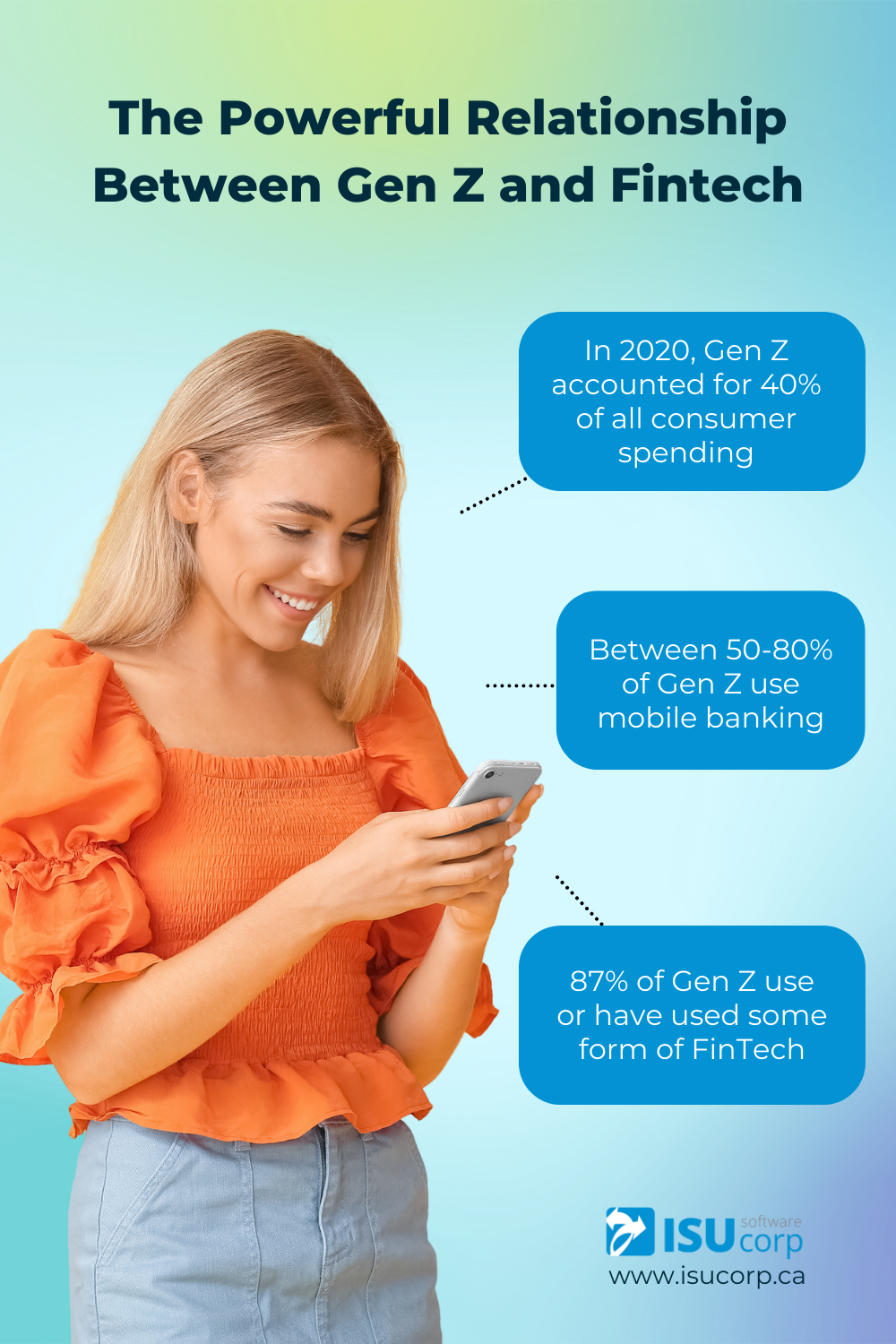
For FinTech companies, this screams opportunity. To put it further into perspective, consider these statistics:

We can see how invested this consumer group is in the products that have been in circulation thus far. Bear in mind that there are about 10,800 FinTech companies in North America alone. Of those, how many can you name off the top of your head? The market is highly competitive, especially for this consumer age range who have grown up with technology and are highly accustomed to day-to-day living with mobile banking and services of its nature. This creates both challenges and opportunities for FinTech companies who are anxious to get their product in front of the younger demographic.

Close up of woman holding her Samsung phone

The first point to note is that Gen Z will not be impressed by convenience or ease in the way millennials embraced services such as Robinhood or Venmo. This is a consumer group that wants personalization and not services that are mass-user-oriented. Of course, FinTech companies know this and have implemented features such as real-time data collection to create offers or users being able to compare their spending habits to that of their peers. The direction these applications are going in is ideal to continue to draw in young users who will use these services for a lifetime. However, to sustain that trajectory, there needs to be contingency planning.

It’s important to understand that Gen Z is not without their concerns, specifically when it comes to the climate, cost of living, and overall social consciousness. These consumers are very observant, especially in the tech space which has become a sizzling hub for marketing. The marketing approach taken by FinTech companies is creative for this demographic since it is aimed to address these concerns with personalized service. Again, being able to see and keep track of spending using digital metrics is a great example of something that would make a consumer feel comfortable using the service. 

When it comes to the feasible aspects that companies should look to implement in their approach, here are three specific factors that are fueling the push of Gen Z to FinTech:

Trepidation around credit card debt: Studies found that only around 17% of Gen Z uses a credit card as their preferred payment method. This is surprising when compared to the usage rate of baby boomers (47%) and millennials (46%). 

There are many reasons that this can be attributed to, such as seeing generations before them suffer from debt or the simple fact that young adults don’t have as easy access to credit. This has caused consumers to lean towards services like buy-now-pay-later which almost half of Gen Z will have used by the end of 2021.

Being able to connect with brands: Going back to the statement that this generation is socially conscious, they will look for that in the brands they trust. For example, FinTech company Stripe supports building technology for carbon removal. A big concern of Gen Z is climate change and building a sustainable infrastructure. By Stripe actively funding carbon removal, they are marketing themselves as more than just a financial service that is likely to attract the young demographic. 

This is just one example of many as companies like Daylight, Aspiration, TreeCard, and many more are making the support of social issues a minimum standard for FinTech companies.

Community: Beyond the knowledge that their money is going towards something good for themselves or a given cause, young consumers want social interaction with their finances. When we look at things like “finfluencers”, crypto trading, or meme stocks, it’s clear that investing and financial education have built a community around themselves that Gen Z has embraced. 

Charley Ma, General Manager at a New York City FinTech company called Alloy, made this statement regarding the company's relationship with Gen Z: "Nowadays, if you're a fintech company, you're wondering how to build interesting communities and get people to engage, respond, and interact with one another". Ma then states, "This is the new method of acquiring the next generation. I believe the features you must develop must be much more community-driven”. 

Overseas embracement

The appeal of FinTech is not simply due to its virtual nature or modernity, rather its inclusivity and ease of use make it much bigger than that. When younger generations get their hands on new technology, they are likely to have a strong influence. India, for example, is home to one of the fastest growing FinTech markets bringing in $9 billion worth of investments in just the last 5 years. A recent trend that is just beginning in the country is gearing financial services specifically towards young adults and children. Many companies taking this approach have even partnered up with financial sharks such as Mastercard and Visa. India recognizes the market influence that younger generations possess and is now focusing its efforts to enhance that and take advantage of the demand.

Another country to look at is the United Kingdom which accounts for 11% of FinTech usage globally. In addition to that, more than 50% of those aged 16-24 in the country manage their money online. Of the 67 million that live in the country, there is an estimated 6.8 million within this age range which would make them account for around 10% of the population. When it comes to the United Kingdom’s economy, experts estimate that FinTech services contribute more than $13 billion and nearly 80,000 jobs. Young adults are estimated to contribute almost $2 billion to that, which in comparison may seem small, but don’t forget the influence this age group has on others. 


The Takeaway

FinTech today has been designed based on the consumer demands that have prevailed in recent years, most notably since 2020 when the digital shift dramatically took over. It is made for users to navigate today’s complex financial landscapes. This is especially important when you consider that people don’t learn today like they did 20 or even 10 years ago. 

Technology is the motivator for consumer usage and a streamlined method to interact and connect with consumers of any industry. FinTech businesses educating and involving the youth is a perfect way to make this technology (and your business) spread in all directions.

Written By Ben Brown

ISU Corp is an award winning software development company, with over 17 years of experience in multiple industries, providing cost effective custom software development, technology management, and IT outsourcing.

Our unique owners mindset reduces development costs and fast-tracks timelines. We help craft the specifications of your project based on your company's needs, to produce the best ROI. Find out why startups, all the way to fortune 500 companies like General Electric, Heinz, and many others have trusted us with their projects. Contact us here.




The Benefits of Custom Application Development

Understanding the significance of having your own customized software can make a life or death difference in your business. Our world today demands everything to be better, faster, newer— and that includes whatever service or product you offer to your clients. So, knowing the benefits of custom application development will give you the bandwidth to make an informed decision on how to best approach innovations in your business.

Let’s start with the the most basic question:

What is Custom Application Development?

Custom application development refers to the process of creating a tailor-made application for certain end-users. This involves designing, coding, and releasing a software program created to make a process more convenient.

For example, if your doctor still uses phone calls to book appointments, a custom app could transform their system to make it easier for patients to not only book appointments virtually but to access their personal healthcare files, a history of visits, prescriptions, and automated reminders of upcoming consultations. This idea can be applied to almost any industry where there are processes between two parties— like a company and a customer, or a business and its employees.

A woman looking down at her iphone

Why Should I Want a Custom Application?

Whether you’re an entrepreneur of one or of five-thousand, the services you offer to your clients and employees can always be improved on. These days, people flock towards the businesses that use the latest technology for the sake of user convenience. Not only does it make their customer’s experience with that company better, it also builds a reputation for the name of the business.

To go back to the example of the doctor’s office, a medical practice that offers that level of convenience and transparency would be turning away clients, while the one that doesn’t may struggle to keep clients and earn good reviews.

To summarize, here are three benefits of custom application development:

  1. Stand Out From the Competition

    A custom application can make a huge difference when customers or employees are comparing which company to go with. There’s a concept called the 2 millimetre shift that emphasizes how small degrees of improvement can create massive waves of success for a business. Those 2 millimetres can set you apart from the businesses that seem to be doing the bare minimum. Offer something just a little better (like a customized application) and all the eyeballs will be on you.

  2. Get all the features you need

    The amazing part of custom application development is that you will end up with a product that is completely tailored-made for your business. From branding to functionality, the processes that used to take a lot of time and effort become seamless and intuitive, getting your business the results it needs faster than ever before— all while looking sleek.

  3. Save your business UNNECESSARY expenses

    Velvetech outlines that using a ready-made app “might seem less expensive at first glance, [but] it often has recurring costs that make it less beneficial in the long run”. By getting all the functionalities you require from the get-go, you also avoid the headache of investing into a one-size-fits-all application only to find that it’s missing integral elements that are vital to making your business successful. Using custom application development from the beginning can save you the unforeseen expenses that other solutions don’t present right away. Create according to your needs, your timeline, and your budget from the start.

How Can I Create a Custom Application?

If you’re convinced that a custom application is the way to go, the next step would be to figure out how to actually make that happen. There are a few options if you have an idea for an app, with some better than others.

A screen displaying colourful rows of code.
  1. Create it yourself

    If you’re a coding and design genius with loads of spare time, you can take on a custom application as a DIY project. It’s completely possible for one person to create a custom app, and it’s pretty cheap since it’s just you labouring away. Whether you can or not depends on your level of skill and the degree of complexity your app idea entails. However, we don’t recommend that you make this a one-person show; custom apps that are beautiful, user-friendly, and functional usually take large teams of experienced engineers. That brings us to our next option;

  2. Hire in-house

    If you own or are part of a business, you could always hire on people to be part of your company and create your app. If you have the time and money to hire the right talent, taking on a custom application may be viable given you have enough resources to spare. But beware: this can cause a detrimental drain on your business. If you don’t balance your work force right, you could find yourself thousands of dollars in the hole without ever seeing the final product. It’s a risk, but an option nonetheless. To avoid these setbacks, see our third option;

  3. Outsource an IT team

    Outsourcing is when you hire a company specializing in software development that comes with their own teams of highly trained coders ready to build anything you’d like. This is great option since you don’t have to take on any risks when it comes to turnover (like when hiring in-house), and you are always going to have enough people working on your app as it’s up to the company you hire to staff appropriately to your project. It can be expensive, but it mitigates your risks and guarantees a ready product at the end of the estimated timeline. If you want to learn more about this option, read about the five benefits of outsourcing.


The Takeaway

Custom application development offers an extensive list of benefits to any given company, including:

  • Attracting more customers and employees

  • Boosting your business processes

  • Saving time and money

The cost is worth the customization, and increases the capability for your business to scale. You can also own the code, and make changes to your app whenever there’s a need. It’s time to be at the cutting-edge of technology and stand out from the crowd. You and your customers will be glad you did.

ISU Corp is an award winning software development company, with over 17 years of experience in multiple industries, providing cost effective custom software development, technology management, and IT outsourcing.

Our unique owners mindset reduces development costs and fast-tracks timelines. We help craft the specifications of your project based on your company's needs, to produce the best ROI. Find out why startups, all the way to fortune 500 companies like General Electric, Heinz, and many others have trusted us with their projects. Contact us here.

How to Build Software With an End-User Mindset

Software development is a solution or an answer to the needs of a technical environment. This can be something as large and complicated as an app with millions of users or as simple as a small-scale e-commerce store. What’s important to note is that these solutions are not for the development team's satisfaction, but rather for the parties who’ve brought their issues to be solved by the development team. Sounds like common sense right? Yes, we understand this concept to be true but it is not always at the forefront of a development team's project roadmap. 

Any software developer can piece together an idea and materialize it in an application. However, for that application to succeed, there needs to be sufficient research, communication with the customer, and testing. In this section, we will be going over how development teams can enforce what’s known as an “end-user mindset” through their development process. 

What is an “end-user” mindset?

The concept is quite simple, but that doesn’t make the execution aspect easy. An end-user mindset is implemented by aligning the development process with the needs of your target audience in mind. This means that consistent improvement, data-driven development, and customer satisfaction remain at the front of all team members' concerns. 

Why is it important?

The reason there is any need to emphasize this approach is that developers commonly release the minimum standard features that check the boxes of the job description but don’t take into account the long-term success of their customers. This isn’t necessarily intentional as there can be issues in communication between developers and the sales team arranging the deadline or the team might simply be unable to identify bugs in their code.

The possible issues are a long list; some can be mitigated with scrum/agile methodologies, but it doesn’t make the product bulletproof or replace the value of tending to the end-user's needs. Even during testing phases, every possible contingency cannot be recognized and tested, which always leaves that risk on the table.

Consider that technology and data are fairly new factors in decision making but they’ve established themselves as pillars of the process. Most businesses today know that technology is a make-or-break factor for the team's success. This makes business in the tech sector extremely volatile. The United States alone is home to nearly 50,000 tech startups, most of which will not survive their first 5-10 years in business. This is the most competitive market in the world, and differentiating your business from the competition with an end-user mindset might be a contributor to your success. 

Here are some tactics to set your organization off on the right foot:

User-centred design (UCD)

User-centred design is a byproduct of user-focused development methodology. This approach follows guidelines that are formed based on analysis from interactions with the end-user. For example, this includes prioritizing touch bases, identifying requirements, and overall observance of the behaviours of the audience throughout the software development process.

Essentially, UCD is meant to throw out the client's old playbook and implement new software solutions as opposed to adding optimization features to the original system. The best software developers will take feedback into account and use it as inspiration for the changes they make to development features. The idea is that consistent communication with your end-user means you’ll know what they want and how they want it. Once that is established, you can build a product that addresses all concerns and will support the application's long-term functionality.

Test the product’s viability

Before full-blown software development is implemented, it will be wise to undergo tests that ensure what you’re building is something people want. A concept can seem like a great idea when you map it out, but nothing will tell the truth like the reaction of the market.

Cost-effective testing: Testing software doesn’t need to be done on a large scale audience. An effective method could be to gather several people and observe how they react and interact with various features of an application. Additionally, simply asking consumers their areas of concern with the system (previous or prototype) and what aspects they like are great for constructing a product that the market wants.

Identify requirements

Basing a product around the desires of your market requires you to compile a report of your product's goals, the overall vision, scope, cost, and timeline. The purpose of this is again, to make sure all necessary features are built into the product without having to go back and change too much. 

When this aspect is neglected, it leads to communication issues, an unorganized workflow, and an overall lack of cohesion which will result in a poor final result. 

Strategically improving the product

New factors (both external and internal) are going to present themselves in the market as well as in your organization. Most companies have a clear vision of how they want their product to look and operate overall but still fall short by neglecting a plan for consistent innovation. Consider some of the social media platforms you or people you know use daily. Notice that there are constant updates to the look and feel of the platform, some of which stay, and others improved on. Who inspires these changes? 

Well, notice the recent trend of platforms adopting TikTok's approach to content delivery (Instagram reels, Snapchat Spotlight, or YouTube shorts). These changes are made from observations in the market. Likely two questions need to be answered when a platform makes strategic changes; What does our audience like? How can we make it our own?

TikTok’s delivery of content is a good example because it demonstrates how platforms notice what keeps users engaged. When platforms saw TikTok’s usage rate blow past theirs, they implemented their approach to even the playing field. 

This concept is the same with any business and it is why software development is so relevant to keep up with ever-changing markets. 

Build scalable software

Branching off the last point, to keep up with changes not only in the market but with your company's digital Infrastructure requires software that can manage the load. Without scalability, companies will run into issues facing downtime, maintenance, and even possible security breaches.

When you start the development process with scalability as a priority, you’re giving your brand the upper hand with benefits such as reduced cost of maintenance, unique user experience, and faster functioning. Every enterprise software will require scalability to meet the demands of the organization.

The Takeaway

Every product is created based on a concept meant to either help a specific niche or change something for everyone. Companies like Apple or Tesla have a vision of everyone using their products, whereas a gaming company or a women's clothing e-commerce store would cater to a specific audience. Whichever side you’re on, an end-user mindset is where the most powerful inspiration comes from. 

Written By Ben Brown

ISU Corp is an award winning software development company, with over 17 years of experience in multiple industries, providing cost effective custom software development, technology management, and IT outsourcing.

Our unique owners mindset reduces development costs and fast-tracks timelines. We help craft the specifications of your project based on your company's needs, to produce the best ROI. Find out why startups, all the way to fortune 500 companies like General Electric, Heinz, and many others have trusted us with their projects. Contact us here.