




15 Artificial Intelligence Statistics for Businesses in 2023

"Mitigating the risk of extinction from AI should be a global priority alongside other societal-scale risks such as pandemics and nuclear war."

- A statement signed by a group of tech leaders in AI, including Same Altman, CEO of ChatGPT

People all over the world are starting to feel a massive technological shift. This is only the beginning of what will be a profound effect on humanity as artificial intelligence continues to progress and show up in different areas of our daily lives. When ChatGPT was launched in November of last year, the future suddenly became palpable, and the question on everyone’s mind remains; how will this shape our future?

Given the adaptable nature of AI, we will see it pop up across industries from healthcare to entertainment. With the ability to handle massive amounts of data, learn at unprecedented rates, and respond to changing needs and environments, AI is a tool that we will likely become more and more dependent on as time goes by– but this may not be a negative thing. In fact, those that embrace the changes will be the ones that thrive. Businesses must leverage AI while keeping a backup plan to survive without it, should it ever come to that.

More specifically, businesses are seeing a shift in operations and processes thanks to the AI tools made available to the public. Companies and corporations are already adopting this new technology and the ones that do so earlier will have an edge over those that are hesitating. So, what’s the best thing you can do for your business right now? Learn. Keep an ear to the ground for the latest trends, developments and uses in technology. Get creative with the ways AI could change the game for you.

To help, we’ve put together a list of the top 15 AI statistics for businesses in 2023 so far– and we plan on updating the list as more developments come up.

Because remember, AI is not some looming sci-fi figure on the horizon of the far future… it’s already here.


Artificial Intelligence Facts and Statistics for 2023:


UNPRECEDENTED GROWTH RATE

From 2023 to 2030, an annual growth rate of 37.3% is expected for Al.

(Forbes, 2023)


LABOR SHORTAGE SOLUTION

25% of companies are using Al to solve the labour shortage issue.

(IBM, 2023)


INCREASED PRODUCTIVITY

Over 60% of businesses believe Al will increase productivity.

(Forbes, 2023)


BUSINESS OWNERS & CHATGPT

97% of business owners believe ChatGPT will help their business.

(Forbes, 2023)


CUSTOMERS TRUST AI

65% of consumers say they'll still trust businesses that use Al.

(Forbes, 2023)


BUSINESSES ALREADY ONBOARD

In 2023, an estimated 35% of businesses already use Al.

(BusinessDIT, 2023)
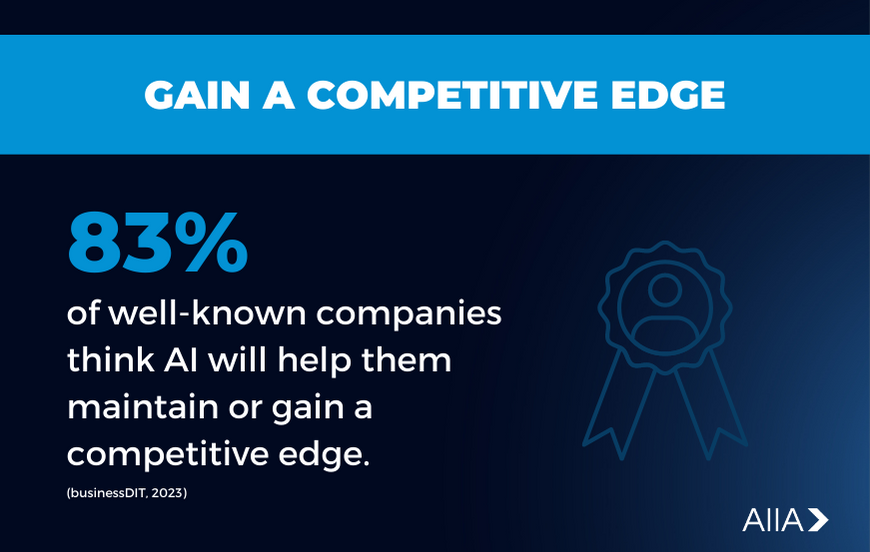
GAIN A COMPETITIVE EDGE

83% of well-known companies think Al will help them maintain or gain a competitive edge.

(BusinessDIT, 2023)

THE CLOCK IS TICKING

42% of companies are exploring Al for its implementation in the future.

(Crossriver Therapy, 2023)

ECONOMIC BOOM

AI could potentially contribute $13 Trillion to the global economy by 2030

(Crossriver Therapy, 2023)

JOBS BECOMING AUTOMATED

By 2030, it's predicted that up to 30% of jobs will be automated through the use of AI technology.

(Crossriver Therapy, 2023)

CUSTOMER SERVICE

AI chatbots can handle 80% of all customer service interactions, saving customer service costs by 30%.

(IBM, 2018)

BUSINESS ADVANTAGE

72% of executives believe that AI will be the most significant business advantage of the future.

(Scaled Agile, Inc., 2023)
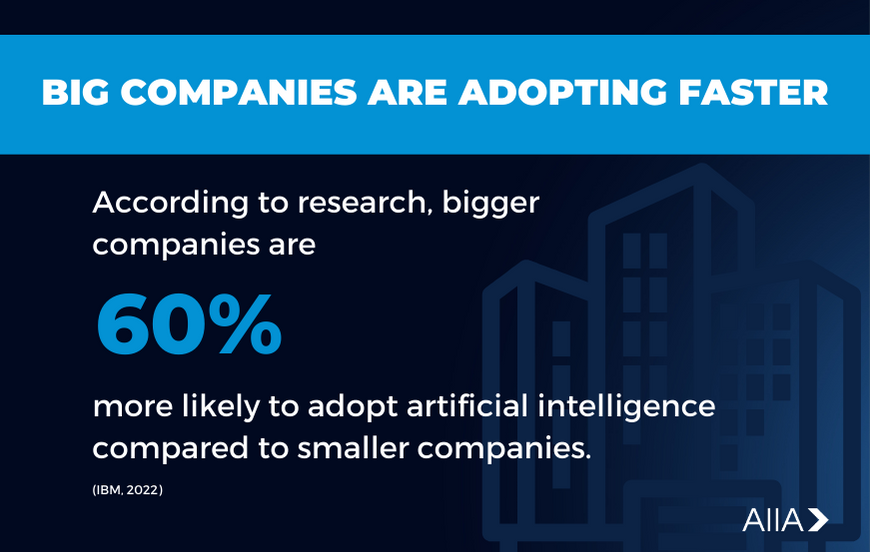
BIG COMPANIES ARE ADOPTING FASTER

According to research, bigger companies are 60% more likely to adopt artificial intelligence compared to smaller companies.

(IBM, 2022)

BUSINESS LEADERS IN AI

Business leaders are roughly twice as likely to report substantial value from AI initiatives to improve productivity, decision-making, customer experience, product and service innovation, employee experience and more.

(PWC, 2022)

THE GLOBAL COMPETITION

Chinese and Indian companies have the highest levels of AI adoption at nearly 60%.

(Crossriver Therapy, 2023)


The Takeaway

In the end, it’s up to business leaders to leverage AI technology to steer their companies in the right direction. This time of uncertainty will be short-lived, and you’ll only have so much time to catch this AI wave. Think about when the Internet first became widespread… With big changes come great opportunities, and while there will be masses too scared to make a move, the handful of innovators that seize this technology will see results. Which one will you be?

Interested in making your move? We can help. Go to our AI page to learn more about how you can get your business to the next level using AI.

Written by Natalie Mansilla

-

ISU Corp is an award-winning software development company, with over 17 years of experience in multiple industries, providing cost-effective custom software development, technology management, and IT outsourcing.

Our unique owners’ mindset reduces development costs and fast-tracks timelines. We help craft the specifications of your project based on your company's needs, to produce the best ROI. Find out why startups, all the way to Fortune 500 companies like General Electric, Heinz, and many others have trusted us with their projects. Contact us here.




4 Key Trends Shaping the Future of Front-End Development

Front-end development has changed so much over the years, the reason being goes beyond technological advancements and is mainly due to the ever-growing demands of users. As a software development company, there’s only one thing you can do when you’re faced with change; embrace it. 

As a software service provider, if you’re not getting better, you’re going backward. Paying attention to what’s going on and continuously evolving your development practices is crucial in today's dynamic landscape. Since front-end development is so high in demand today, programmers have made it a key point of focus to stay ahead of the curve. 

In this article, we’ll be going over 4 key trends that we’re seeing in front-end development with various tools and frameworks that are shaping the future of web development:

An Emphasis on UX

As businesses continue to shift their operations online, the demand for user-friendly websites and applications rises. This trend has led to the development of new tools and frameworks that enhance the process of creating a great user experience such as:

  1. Loop11

  2. Framer X

  3. Adobe XD

  4. Gaby.js

  5. Vue.js

  6. Hotjar

There are many more but these are just a few of the trending options at the moment.

In addition to this, the emphasis is big on accessibility and inclusivity; businesses must ensure that everyone can easily access and use their digital platforms on any device from just about anywhere.

Today there are AI-driven tools meant to enhance the results of development tools and frameworks by using algorithms to predict user behaviour and identify patterns in user data. By analyzing these interactions among users, software developers can consistently make optimizations. 

A hot choice of tool for this right now is Microsoft IntelliTest which enhances the testing phase during development for .NET code. What IntelliTest will do is generate a suite of tests for .NET code, which then allows developers to identify those pesky bugs early and ultimately mitigate high test maintenance costs. With its AI-driven capabilities, IntelliTest can automatically evolve the test suite alongside the evolving code, ensuring overall comprehensive coverage in real-time.

Reactive Programming

This is one everyone’s got their eye on in 2023, mainly because of how scalable and responsive applications materialize with reactive programming. You might have thought of traditional programming like waiting in a never-ending line at the grocery store. Everything has to happen in order, step by step, and if something takes too long, everything gets held up. The draw to reactive programming then, is because it allows front-end developers to handle multiple tasks at once, it’s essentially like juggling. Things can happen independently and simultaneously without blocking each other which allows for a more dynamic user experience.

The kind of applications that benefit most from reactive programming are the ones that need to handle a high volume of concurrent tasks. Imagine you’re running a social media platform, and millions of users are actively posting 24/7. In traditional programming, the influx of user-generated content would be overwhelming. It'd be like trying to read every single book in a library one by one. The benefit of reactive programming is that it lets you handle user interactions simultaneously. 

You get the picture, reactive programming can process information in ways traditional programming simply can't match. Reactive X is a great tool for this since it’s flexible and can handle frontend, cross-platform, and backend development. When it comes to frontend development with Reactive X, you can use libraries like RxJS (for JavaScript), RxSwift (for Swift), or Rx.NET (for .NET) to create event-driven applications on the front end.

Performance Tuning

Whether it’s an application or a website, users want speed and responsiveness more than a fancy look. Optimizing performance is a multifaceted topic that must be prioritized to create a well-rounded UI/UX. Here are 3 techniques to make this happen:

1. Caching

Implement caching to store data you access frequently and you’ll avoid redundant calculations. For instance, if you have an API that retrieves data from a remote server, cache the response to avoid making the same request multiple times.

2. Asynchronous Processing 

Utilizing this will improve responsiveness by handling multiple tasks concurrently (as we’ve already mentioned with reactive programming). This prevents blocking in the main thread and keeps the UI responsive. 

3. Optimize code

Always look for areas in your code that can be optimized. For instance, if you have a loop that iterates over a large collection, think about a data structure that’s more efficient like hash maps opposed to an array. In addition to this, try to minimize unnecessary function calls.

Going Serverless

Serverless architecture is great for developers, though business owners and end-users get their share of benefits as well. For developers, going serverless means less energy is being spent on managing the infrastructure, allowing them to focus on coding and the innovation side of things. 

The cloud provider ends up taking care of the management aspect which is great for scalability and maintenance, but monitoring is still a necessity. 5 tools that are great for serverless monitoring include:

  1. SolarWinds

  2. Amazon CloudWatch

  3. New Relic

  4. Lumigo

  5. Pingdom

Serverless computing is most notable for its ability to scale according to the user demands of the platform. Tools like the ones listed above give users real-time insights into metrics, logs, and events, which proactively identifies issues and ensures a smooth operation of serverless applications all-around.

The Takeaway

With everything considered, it’s clear that today’s landscape demands we emphasize constantly finding new ways to optimize front-end development. Remember, what’s relevant today may soon not be, which is why complacency so often eliminates businesses that don’t look for or accept change. 

With software development, complacency can’t be a factor for even one day while running your business. We need to embrace new frameworks, tools, and methodologies that enhance productivity and efficiency while prioritizing agility and adaptability to provide the best product possible. 

Written By Ben Brown

ISU Corp is an award-winning software development company, with over 17 years of experience in multiple industries, providing cost-effective custom software development, technology management, and IT outsourcing.

Our unique owners’ mindset reduces development costs and fast-tracks timelines. We help craft the specifications of your project based on your company's needs, to produce the best ROI. Find out why startups, all the way to Fortune 500 companies like General Electric, Heinz, and many others have trusted us with their projects. Contact us here.



How Does AI Consulting Work?

AI consulting services are the next step for software development companies during the next decade. Why do I say this? It’s simple; the job of a software developer is becoming less hands-on and more focused on orchestrating complex systems. Companies know that the shift demands a strategy, how that strategy is executed however is up to the business. In this article, we’ll be going over the AI consulting route, a strategy that helps software development companies continue to add value in an evolving tech landscape. 

The introduction of AI has presented an opportunity, not a threat, to companies working in custom software development. The decades of expertise leading up to this point have given us the knowledge required to push companies forward using new technologies. However, the most challenging aspect, which has been difficult for years, is finding that perfect match and getting companies and clients to embrace the change. However, this is what’s going to make AI consultancy so inextricably valuable during this time of change. 

How Years of Software Development Have Prepared Us For AI

Artificial Intelligence seemed to form a rain cloud over businesses that are now scrambling for a cover, that is, a new strategy. However, these companies working in Marketing, Retail, Finance, Healthcare, you name it, might lack the required expertise to effectively execute a digital transformation with AI. But like any change, a little guidance can make a world of difference. 

Software development before modern tools has forged a toolkit for providers that directly carries over to success with analyzing businesses and integrating AI. Here are 3 key carryovers:

Agile Development: We’ve recently talked about the benefits of agile development with AI but it’s certainly worth a reiteration. Agile methodology aligns significantly with the iterative nature of AI development, a context where models are trained, evaluated, and refined over and over. The experience gained from agile development methodologies will be great when identifying opportunities and eventually integrating AI since it facilitates efficient development and adaptation to evolving requirements.

Data Management and Processing Ability: Software development has always been about working with mass amounts of data since applications need to analyze and manage large volumes of it. This experience has provided a solid foundation for AI, where again, data plays a crucial role. Software developers have expertise in data modelling, database management, and manipulating data, which are all going to be essential for AI algorithms to learn and perform up to standard.

Algorithmic Thinking: Breaking down a complex problem into micro steps like you would when writing code is going to serve well when approaching Machine Learning algorithms. What algorithmic thinking does here is slow you down and allow you to identify the specific objectives, data requirements, and preprocessing steps necessary for the system.

So first of all, what does a company look for in an AI consultancy? Well, it isn’t just one thing, it’s going to be unique in every case, but the following questions are typically the best to have answers to before seeking help:

  1. How critical is it for you to implement an AI solution?

    • What does your company stand to gain from implementing AI? Before you can expect consultants to deliver you a high-quality product, you must first understand and believe in the vision. 

  2. Does your consultant know what they’re doing?

    • It might seem like an oxymoron but depending on the consultant's background, their experience levels with AI and your industry can vary. Look for the ones who have been around for a while and who have a deep understanding of AI technologies in addition to relevant industry experience.

  3. How will an AI system align with your business objectives?

    • Is your staff prepared to handle a new system? Companies that have succeeded for decades know that any changes made to workflows need to align with the company's values and goals. 

It’s the small details that make a big difference when it comes to selecting an AI consultant. But just like any software project, companies have to understand the purpose of integration.

Working With Your Chosen Consultant

Okay, so you’ve found someone you’re comfortable with - you’re confident in the vision behind your AI digital transformation, you work out the details with your consultant and now it’s time to get to work… What does the process look like?

When collaborating with an experienced team, the initial step involves conducting an assessment of your current software development resources and initiatives. What this assessment will do is identify any gaps or shortcomings in your current approach. These gaps are going to be the focus of your work together as it’s where you’re going to implement the solutions. 

Next, you’re going to go over it together. By doing so, you can align on the specific challenges and areas that require attention.

During these discussions, the team will want your input and gather additional context about your priorities. This approach with an emphasis on collaboration ensures that the proposed solutions are not only appropriate but align with your strategy and vision so that they can be sustained long-term. Then, you’ll take a look at the recommendation outline which is where you’ll see the solution proposals. You can then give your input and begin to think about logistics.

Beyond this, the process becomes focused on refining and implementing the solutions. It will prioritize user training, as your team will need to understand the unique aspects and functionalities of the AI solutions that they wouldn’t be able to get answers to anywhere else. 

What is it Going to do For You?

We could list the benefits of AI and make it look pretty but the fact is even the benefits change depending on the context. What AI brings to the table for a finance company won’t be the same as what it brings to a healthcare organization. The true value of AI consultancy is its ability to customize and tailor solutions to your specific industry and business needs.

You’ll walk away with actionable insights and, if you execute them effectively, an infrastructure that will give you a competitive advantage and allow you to scale.

The Takeaway

Trying new things as a business is an ongoing process and it can be very difficult initially but remarkably rewarding down the line. This is a digital world now, and it’s moving towards automation and efficiency. This time is unique in that businesses get to try different things to find what works. The right AI consultant can work wonders for you - but in order to do so, you must be willing to embrace and adapt.

Written By Ben Brown

ISU Corp is an award-winning software development company, with over 17 years of experience in multiple industries, providing cost-effective custom software development, technology management, and IT outsourcing.

Our unique owners’ mindset reduces development costs and fast-tracks timelines. We help craft the specifications of your project based on your company's needs, to produce the best ROI. Find out why startups, all the way to Fortune 500 companies like General Electric, Heinz, and many others have trusted us with their projects. Contact us here.