
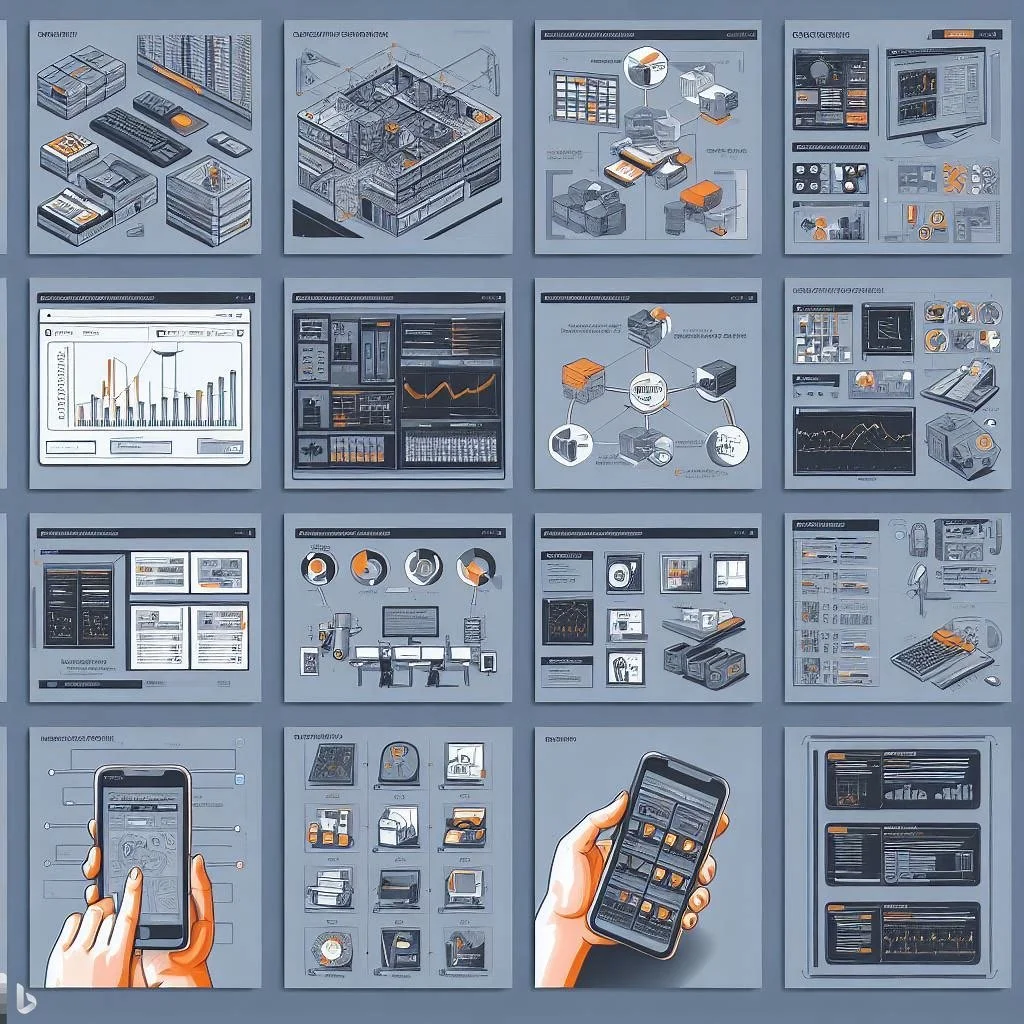



Create a Great Mobile Experience with AR and AI 

Enhanced Mobile Experience with AR & AI 

The combination of two highly advanced technological tools such as Augmented Reality (AR) and Artificial Intelligence (AI) becomes the ultimate digital dream. When AI is incorporated into any type of AR application, that AR world benefits from the bridging of the two tools. 

The use of both AR and AI enables mobile app developers to create more captivating and interactive apps. Let’s take a look into the specifics and see how the combination of AR and AI can create something incredible… 

Complementing One Another 

If you’re sick and tired of having customer complaints, consider combining AR and AI to increase customer satisfaction (and decrease your stress)! Many companies are beginning to develop the latest and greatest mobile apps which will be integrated with AR and AI technology. 

After all, AR would not exist without AI. Although the two have distinct characteristics and technologies, they’re able to sync with each other on multiple apps and platforms. Each is able to leverage one another’s best features in order to build the best possible mobile experience.  

AI and AR go hand-in-hand as AI enables AR with its accessibility to a multidimensional interactive mode, along with the physical environment. With access to manipulate 2D and 3D virtual objects with your body language, eyes and words! 

It’s projected that within the next 5 years, AR apps will take off and grow to be more and more popular. This is why it is crucial to obtain the right software development kits (SDK) and application program interfaces (API), as without these, your technologies will find it hard to succeed. 

Which SDKs and APIs are Available Today? 

As SDK and API capabilities are continuously expanding, there are more commercial opportunities available to increase your business. Some examples being:

  • Vuforia: AR SDK which allows app developers to build immersive and mobile-centric AR experiences. It can support both Android and iOS which permits brands to create apps with less technical risks. 

  • ARCore: This is an AR SDK which is Google’s proprietary. Developers are able to run AR apps on mobile devices with the supporting iOS devices. Developers can build highly advanced AR experiences through the use of ARCore. 

  • Core ML: This API is a machine learning platform which is used on Apple devices. It allows you to get real-time projections of live images on your mobile device. The real-time factor, along with its low latency are the two greatest advantages. To top it off, Core ML can be used without any network connection! 

  • TensorFlow Lite: This open-source framework involves deep learning and it focuses on mobile interference. It enables developers to use their own custom models. 

A Few Ways to Combine AR and AI 

  1. Speech recognition: AI listens to what you say, while AR makes that appear. For instance, if you say the word “bagel”, a virtual bagel will be present in front of you. 

  2. Image tracking and image recognition: This method allows customers to see how an object would fit into a specific setting. With the combination of AR and AI, users can move photos of multiple items into a single image of a certain place and assist them in making their decision. A perfect example of where this can be used is: IKEA. 

  3. Human pose estimation: This allows for the detection of human poses and figures while predicting the positions of one’s joints in a video or image. In turn, this technique can be used for controlling AR content. 

  4. Education: As technology is making its way to schools, it allows students to obtain different perspectives through the use of virtual reality. Students are able to interact and visualize with 3D versions of a human body - what better way to teach science? 

  5. Recognizing and labeling: If you take a camera and point it towards an image, an AR app is able to then display a label which indicates the object in the image when the technology recognizes it. 

  6. Car recognition: While using a smartphone camera, customers can sit in a car and discover information about the car’s interior features. No need to download any app for this! 

  7. Object detection: If you’re looking to detect the position and extent of certain objects that you’ve seen in images or videos, then you need to combine AR and AI technologies! This model allows an interaction between digital and physical objects, and of course it is mobile-friendly. 


Start Your Virtual Journey Today

If you’re looking to excel your business and satisfy your customer’s needs, then consider AR and AI combination technologies. Together, these tools will ameliorate mobile experiences with developers being able to design greater experiences and customers being able to gain more diverse perspectives. 

There are so many AR and AI applications, it can be difficult to choose just one! To learn more about how ISU Corp can help you create an amazing mobile experience for your business, get in touch with us today! 


How Data Analytics and IoT Can Help Grow Your Business

As our digital world continues to advance, we are seeing more and more technological tools coming into play. As such, it is inevitable that data and IoT go hand in hand with one another. Data is prominent in terms of consumption and production, growing at a fast pace with each passing day. 

With this increase in expansion, IoT is beginning to grow along with it, with approximately 30 billion IoT connected devices by the end of this year! 

What Exactly is IoT? 

It’s an interconnection of multiple devices, technologies, networks and human resources; all put together to achieve a shared goal. IoT-based applications have proved to provide benefits to the users, who have a wide span of applications to choose from, depending on which would suit each sector's needs. 


Data analytics play an important role in IoT as data is integrated into the technology. The data that’s generated from IoT devices can only produce value if it is analyzed properly. Data analytics is a process in which large and small data is examined with different modes of data tools in order to extract patterns, trends, and stats. 


Such results assist organizations in proactive rather than reactive planning. These conclusions allow a business to engage with the data while implementing effective decision-making for next steps. 


Positive Outcomes for Your Business 

By merging IoT with data analytics, you will certainly be striving for success! Analytics tools help your business comprehend and make use of their datasets. These 4 points will provide you with further explanation: 

  • Volume: There is an immense amount of data that IoT applications stem from. Businesses using these resources need to manage these large amounts of data whilst analyzing the same dataset to configure patterns and trends within the data. This is why data analytics is beneficial, as this software can easily and efficiently analyze the data in real-time. 

  • Structure: IoT devices have data sets that could potentially obtain a diverse structure system. Such as: unstructured, semi-structured and structured data sets. There could also be differences between the data types and formats - which can be analyzed by automated tools and software. 

  • Revenue: Every business knows that insights are the way to go! And what better way to gain insight into your customers preferences than by using data analytics? Ultimately, this leads to offers and services in correlation with customer demands. As such, the revenue and profits gained will improve significantly for your organization. 

  • Competition: When first starting out with IoT, you might be overwhelmed with the vast landscape of application developers and providers available to choose from. With data analytics, your time and money will be well spent. It will help your business gain a competitive advantage in the market. 


Now that we know why data analytics are beneficial for IoT, let’s look at the different types of data analytics: 

  • Streaming Analytics: (also known as event stream processing) This form of analytics is prominent in analyzing large, real-time data sets. With streaming real-time data, you’re able to analyze critical situations and provide an immediate response. The types of IoT apps that would benefit most from this are: air fleet tracking, traffic analysis and financial transactions. 


  • Spatial Analytics: This method is used for geographical analyzation through varying patterns found in data sets. By taking these geographic patterns, you’re able to see what the spatial relationship is between physical objects. This method is especially useful for location-based IoT apps like smart parking. 

  • Time Series Analytics: With an evident name, this method focuses on time-based data to be analyzed for trends and patterns. If you’re using IoT apps such as weather forecasts and health monitoring, this analytics form will prove to be beneficial. 


  • Perspective Analysis: This method combines descriptive and predictive data analysis. It helps your business understand what the next steps should be in terms of action for particular situations. The best form of IoT applications for this would be commercial ones, whereby this information would be inputted into your analytics tool to gain greater conclusive results. 


Climbing up the Ladder of Success 

These IoT investments strongly benefit from the application and use of data analytics, as it has been proven time and time again! With the constant technological advancements, there are always new areas in which data analytics is able to be applied in correspondence with IoT. 

For example, every business uses marketing to promote their products and reach out to their audience. Actionable marketing can be easily done with the application of data analytics to the product usage. Along with IoT analytics, which allows the safety and surveillance performances applicable through video sensors and data analytics methods. 

So, to sum everything up, data analytics assists IoT in improving revenues, gaining a competitive advantage and increasing customer engagement. 


Collaborating with ISU Corp will provide you with IoT and data analytical leverage. Contact us today to learn more! 


Why Business and Functional Requirements are Crucial for your Organization

A crucial aspect of the success of any project is getting the requirements right in a product development process. The eventual success or failure of any project hangs on the attribute of the requirements. Consequently, understanding the requirements and using them to the fullest extent is vital for a project’s success.

In this blog, we will explore the differences between Business Requirements and Functional Requirements. Taking care of the issue is a top priority, which is why it is necessary to comprehend the differences between the two. 

Business Requirements

Understanding the ‘why’ part of a project is an essential component of delivering a perfect experience to your clients. Focusing on why also means you are emphasizing the business requirements.

A business requirements document aims to communicate a complete picture of a project, so everyone is clear on what must be done and when. These documents explain what a system and a solution ought to do. They describe the degree to which a project should address business needs.

Business Requirements Document (BRD)

The business requirements are recorded in the Business Requirements Document. A BRD communicates essential business needs. The customers and the users are the primary target audience of a BRD. With a brilliant business requirement document, the anticipated goal of creating an effective product within the specified time limit can be achieved.

It includes the following components:

  • The vision of the project

  • Objectives of the project

  • Background of the project

  • Scope of the project

  • Stakeholder identification

  • Detailed business requirements

  • Scope of the solution

  • Project constraints: available resources, time frame, and cost

Guidelines for writing a business requirements document (BRD)

Now that we have discussed what a BRD should achieve, these are tips to guide you to write an excellent business requirements document.

  • Do due diligence on past projects

  • Authenticate the documents

  • Apply strong requirements elicitations 

  • Make use of simple language without jargon and passive tones

  • Incorporate visuals


Functional Requirements

As the name implies, Functional Requirements are a narrative of the service that the software offers, which is a description of the functionalities of the software. A function comprises inputs to the software system, its behaviour, and outputs.

It can be data manipulation, user interaction, calculation, business process, or any other functionality that illustrates what a framework should accomplish. Functional requirements must not be ambiguous and should align with the project needs.

Functional Requirements Document (FRD)

The Functional Requirements Document summarizes the functions required to achieve the project needs. It involves the client’s consent to find a product acceptable if it delivers the competencies indicated in the FRD. As such, the developers agree to offer the capabilities stated.

FRD includes the following elements:

  • The objective of the project

  • Scope of the project

  • Comprehensive functional requirements

  • Expectations and constraints

  • Illustration of the functional requirements using information architecture. 


Tips for writing a functional requirements document (FRD)

Creating a functional requirements document is just like writing a memo to all the team members, informing them about the technical tasks you would want them to execute.

The following tips would help you write a useful FRD:

  • Verify your facts

  • Use clean language

  • Incorporate diagrams and illustrations 

  • Observe time frames


Challenges in writing good business and functional requirements

Writing good and valid business and functional requirements can be difficult. Common challenges that are faced while writing these requirement documents include:

  • Using vague acronyms

  • Using the wrong sentence structure

  • Writing about execution rather than requirements

  • An incomplete understanding of the requirement and not asking for clarification

  • Incorrect interpretation of the requirement and using personal filters to the data that alters the objective

  • Execution decisions should be delayed in the Requirements Elicitation process


Solidify Your Business

Now that we have broadly discussed that requirements are the foundation of every business, will you reconsider how your business does business?

Both business and functional requirements form the groundwork of practical business analysis. The “why” of a project is taken out of the business requirements, and the functional requirements elucidate the “how” of the project.

Get in touch with us to discuss custom software solutions and cloud services for your business.