


4 Ways to Optimize Your Business Using AI

At this moment, companies might have at least 6 months to get their act together before AI comes back with some hard changes for their industry. 

I want you to imagine your business right now, whether you’re the owner, an employee, or any sort of stakeholder. If you’ve been around for longer than 10 years, there’s a big chance you’ve had several major disruptions in your industry that you were forced to overcome.

Now, we stand at the cusp of yet another disruption that will completely transform not only the way your business operates, but the world itself. If you think that’s an overstatement, stop and think; how much does your company currently spend on employee salaries per month? I want you to think about that number and then look around at some AI service providers and see how much you could implement with that sum. 

It’s a harsh vision, especially to think that jobs people have done for decades could be taken over by AI. However, this article isn’t meant to instill fear about job security, we simply believe that by understanding the transformative potential of AI and its specific features, companies can make informed decisions to stay well ahead of the curve and remain competitive. With that said, here are 4 ways businesses can optimize their operations to adjust to today’s demands:

1. Managing The Supply Chain

Predictive analytics are miraculous in their range of abilities. Most notable is supply chain management, where the AI system can easily identify fluctuations in demand well in advance. This enables proactive planning and minimizes the carrying costs of inventory. 

What AI algorithms can do here specifically is analyze historical data, market trends, weather patterns, and social media sentiment to predict future demand with unbelievable accuracy. This is a big advancement whether your company actually produces material goods or offers a specific service.

For service-oriented businesses, effectively managing operational costs while meeting customer needs is the name of the game. The reason I bring this up is because predictive analytics are often exclusively discussed regarding their ability to serve companies heavy on manufacturing demands. But that goes against the whole basis of AI pertaining to its ability to manage data in just about any industry, so we’ll lay it out clearly.

For service providers, AI algorithms can forecast service demand which then allows companies to allocate their staff and resources more effectively. There’s always been that phrase business owners use: “Well I can’t predict the future, but…”. Now there’s no need for this, as AI algorithms can make accurate predictions.

2. The Core 4

Every business strategizing with AI is checking off one of the following boxes: efficiency, effectiveness, expertise, or innovation. According to a report from developer Jacob Bergdahl, each strategy is broken down in terms of the company’s data and will look something like this:

The efficiency strategy: Low data > Low work complexity

The effectiveness strategy: High data > Low work complexity

The expert strategy: Low data > High work complexity

The innovation strategy: High data > High work complexity

When strategizing with AI, first identify where your needs fall on this scale. If you don’t, you’ll end up with a solution that doesn’t meet your needs and isn’t sustainable. 

3. The Volume and Complexity of Data

Branching off the previous point, as markets continue to shift online, the amount of data businesses accumulate increases exponentially. With that being said, the number one reason businesses can survive this kind of change is through their ability and willingness to pivot. 

As a means to do so, the digital landscape has opened up new avenues for collecting as well as generating vast amounts of data from various sources such as user interactions, transactions, social media, etc. What’s important to know is that this rise in data gives businesses just as many opportunities as it does challenges.

On the one hand, the abundance of data gives businesses valuable insights into customer behaviour, market trends, and how their performance stacks up. It enables companies to make “data-driven decisions”, which are based on initiatives such as personalizing customer experiences, optimizing processes, and of course, identifying new growth opportunities. 

However, the sheer volume and complexity of this data can quickly become overwhelming without the right strategies and technologies in place. To mitigate this risk, businesses must integrate data management tools that can streamline data workflows. Here’s how this can happen:

Data Storage and Infrastructure: Cloud-based storage solutions, data lakes, and distributed databases all contribute to building a scalable and secure data storage infrastructure. By investing in the components needed for this infrastructure, companies will be a lot more flexible. 

Data Integration and Consolidation: Businesses often encounter data silos, where valuable information is scattered across different systems and departments. What implementing data integration strategies and tools can do is help consolidate and unify all of that data, which will give you an overall holistic view of your organization's operations and customer interactions.

Data-driven Decision-Making: This is a hot-button topic right now and for good reason. Encouraging a data-driven culture within an organization is vital to align the team with the vision behind change and ultimately where the industry is headed. Training employees on data literacy, promoting data-driven decision-making processes, and fostering a mindset that values data-driven insights will empower people to get behind these processes and leverage their capabilities.

4. Security

Cyber extortion and ransomware attacks have been on a huge upswing in 2023. In March, Ferrari, Skylink, and Alliance Healthcare were a few entities that faced serious issues with breaches. The threat of ransomware and malware becomes more significant as the volume of data that businesses work with increases.

For this reason and several others, artificial intelligence is a must for enterprise businesses. Here’s how it makes a difference:

Recognize Threats Early

An AI-powered security system is a digital detective that’s never off the clock. It will analyze data from your network traffic, log files, and user behaviour, to detect anomalies and potential indicators of cyber attacks. The machine learning algorithms embedded in these systems can identify irregularities that signal ransomware and malware, which will give you a response to early threat detection.

Respond to Threats Early and Automatically

When a security breach is detected, AI systems can trigger immediate responses, which might include isolating affected systems, blocking malicious connections, or initiating backup and recovery procedures. 

The difference between your business using an AI system and your competitor who’s too slow to strategize comes down to one thing: vulnerability. Your competitor is going to be highly susceptible to cyber threats and attacks without this threat detection and response system, while you'll have a robust defence in place.

Fixing Weak Spots

AI can help you find and prioritize vulnerabilities in your IT setup. It looks at things like system configurations, software versions, and patches to identify any weak points that ransomware and malware could exploit.

What to Know Going Forward

It’s a lot right? This information is as general as it gets when looking at the things companies need to do with AI because there’s so much subjectivity with IT. The best thing you can do as a business starting your journey with AI is to research and evaluate reputable AI service providers that offer solutions aligned with your business needs. Have consultations and ask for demonstrations to understand how their AI tools can be integrated into your existing infrastructure. Consider factors such as scalability, ease of implementation, and ongoing support to ensure a smooth transition.

Written By Ben Brown

ISU Corp is an award-winning software development company, with over 17 years of experience in multiple industries, providing cost-effective custom software development, technology management, and IT outsourcing.

Our unique owners’ mindset reduces development costs and fast-tracks timelines. We help craft the specifications of your project based on your company's needs, to produce the best ROI. Find out why startups, all the way to Fortune 500 companies like General Electric, Heinz, and many others have trusted us with their projects. Contact us here.


15 Artificial Intelligence Statistics for Businesses in 2023

"Mitigating the risk of extinction from AI should be a global priority alongside other societal-scale risks such as pandemics and nuclear war."

- A statement signed by a group of tech leaders in AI, including Same Altman, CEO of ChatGPT

People all over the world are starting to feel a massive technological shift. This is only the beginning of what will be a profound effect on humanity as artificial intelligence continues to progress and show up in different areas of our daily lives. When ChatGPT was launched in November of last year, the future suddenly became palpable, and the question on everyone’s mind remains; how will this shape our future?

Given the adaptable nature of AI, we will see it pop up across industries from healthcare to entertainment. With the ability to handle massive amounts of data, learn at unprecedented rates, and respond to changing needs and environments, AI is a tool that we will likely become more and more dependent on as time goes by– but this may not be a negative thing. In fact, those that embrace the changes will be the ones that thrive. Businesses must leverage AI while keeping a backup plan to survive without it, should it ever come to that.

More specifically, businesses are seeing a shift in operations and processes thanks to the AI tools made available to the public. Companies and corporations are already adopting this new technology and the ones that do so earlier will have an edge over those that are hesitating. So, what’s the best thing you can do for your business right now? Learn. Keep an ear to the ground for the latest trends, developments and uses in technology. Get creative with the ways AI could change the game for you.

To help, we’ve put together a list of the top 15 AI statistics for businesses in 2023 so far– and we plan on updating the list as more developments come up.

Because remember, AI is not some looming sci-fi figure on the horizon of the far future… it’s already here.


Artificial Intelligence Facts and Statistics for 2023:


UNPRECEDENTED GROWTH RATE

From 2023 to 2030, an annual growth rate of 37.3% is expected for Al.

(Forbes, 2023)


LABOR SHORTAGE SOLUTION

25% of companies are using Al to solve the labour shortage issue.

(IBM, 2023)


INCREASED PRODUCTIVITY

Over 60% of businesses believe Al will increase productivity.

(Forbes, 2023)


BUSINESS OWNERS & CHATGPT

97% of business owners believe ChatGPT will help their business.

(Forbes, 2023)


CUSTOMERS TRUST AI

65% of consumers say they'll still trust businesses that use Al.

(Forbes, 2023)


BUSINESSES ALREADY ONBOARD

In 2023, an estimated 35% of businesses already use Al.

(BusinessDIT, 2023)

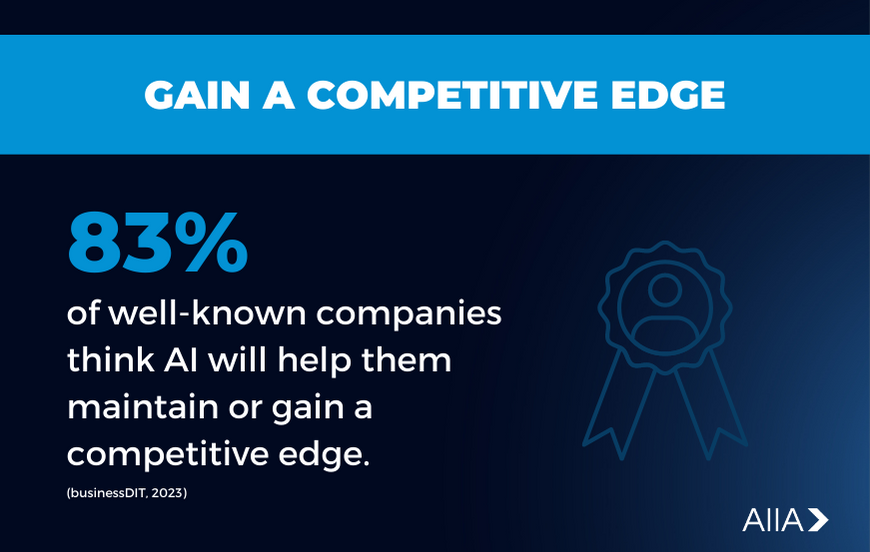
GAIN A COMPETITIVE EDGE

83% of well-known companies think Al will help them maintain or gain a competitive edge.

(BusinessDIT, 2023)

THE CLOCK IS TICKING

42% of companies are exploring Al for its implementation in the future.

(Crossriver Therapy, 2023)

ECONOMIC BOOM

AI could potentially contribute $13 Trillion to the global economy by 2030

(Crossriver Therapy, 2023)

JOBS BECOMING AUTOMATED

By 2030, it's predicted that up to 30% of jobs will be automated through the use of AI technology.

(Crossriver Therapy, 2023)

CUSTOMER SERVICE

AI chatbots can handle 80% of all customer service interactions, saving customer service costs by 30%.

(IBM, 2018)

BUSINESS ADVANTAGE

72% of executives believe that AI will be the most significant business advantage of the future.

(Scaled Agile, Inc., 2023)

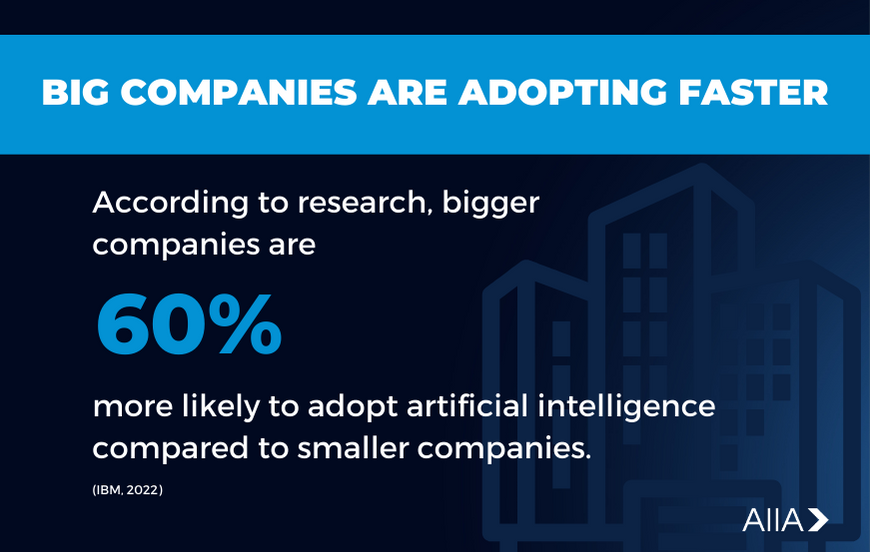
BIG COMPANIES ARE ADOPTING FASTER

According to research, bigger companies are 60% more likely to adopt artificial intelligence compared to smaller companies.

(IBM, 2022)

BUSINESS LEADERS IN AI

Business leaders are roughly twice as likely to report substantial value from AI initiatives to improve productivity, decision-making, customer experience, product and service innovation, employee experience and more.

(PWC, 2022)

THE GLOBAL COMPETITION

Chinese and Indian companies have the highest levels of AI adoption at nearly 60%.

(Crossriver Therapy, 2023)


The Takeaway

In the end, it’s up to business leaders to leverage AI technology to steer their companies in the right direction. This time of uncertainty will be short-lived, and you’ll only have so much time to catch this AI wave. Think about when the Internet first became widespread… With big changes come great opportunities, and while there will be masses too scared to make a move, the handful of innovators that seize this technology will see results. Which one will you be?

Interested in making your move? We can help. Go to our AI page to learn more about how you can get your business to the next level using AI.

Written by Natalie Mansilla

-

ISU Corp is an award-winning software development company, with over 17 years of experience in multiple industries, providing cost-effective custom software development, technology management, and IT outsourcing.

Our unique owners’ mindset reduces development costs and fast-tracks timelines. We help craft the specifications of your project based on your company's needs, to produce the best ROI. Find out why startups, all the way to Fortune 500 companies like General Electric, Heinz, and many others have trusted us with their projects. Contact us here.


4 Key Trends Shaping the Future of Front-End Development

Front-end development has changed so much over the years, the reason being goes beyond technological advancements and is mainly due to the ever-growing demands of users. As a software development company, there’s only one thing you can do when you’re faced with change; embrace it. 

As a software service provider, if you’re not getting better, you’re going backward. Paying attention to what’s going on and continuously evolving your development practices is crucial in today's dynamic landscape. Since front-end development is so high in demand today, programmers have made it a key point of focus to stay ahead of the curve. 

In this article, we’ll be going over 4 key trends that we’re seeing in front-end development with various tools and frameworks that are shaping the future of web development:

An Emphasis on UX

As businesses continue to shift their operations online, the demand for user-friendly websites and applications rises. This trend has led to the development of new tools and frameworks that enhance the process of creating a great user experience such as:

  1. Loop11

  2. Framer X

  3. Adobe XD

  4. Gaby.js

  5. Vue.js

  6. Hotjar

There are many more but these are just a few of the trending options at the moment.

In addition to this, the emphasis is big on accessibility and inclusivity; businesses must ensure that everyone can easily access and use their digital platforms on any device from just about anywhere.

Today there are AI-driven tools meant to enhance the results of development tools and frameworks by using algorithms to predict user behaviour and identify patterns in user data. By analyzing these interactions among users, software developers can consistently make optimizations. 

A hot choice of tool for this right now is Microsoft IntelliTest which enhances the testing phase during development for .NET code. What IntelliTest will do is generate a suite of tests for .NET code, which then allows developers to identify those pesky bugs early and ultimately mitigate high test maintenance costs. With its AI-driven capabilities, IntelliTest can automatically evolve the test suite alongside the evolving code, ensuring overall comprehensive coverage in real-time.

Reactive Programming

This is one everyone’s got their eye on in 2023, mainly because of how scalable and responsive applications materialize with reactive programming. You might have thought of traditional programming like waiting in a never-ending line at the grocery store. Everything has to happen in order, step by step, and if something takes too long, everything gets held up. The draw to reactive programming then, is because it allows front-end developers to handle multiple tasks at once, it’s essentially like juggling. Things can happen independently and simultaneously without blocking each other which allows for a more dynamic user experience.

The kind of applications that benefit most from reactive programming are the ones that need to handle a high volume of concurrent tasks. Imagine you’re running a social media platform, and millions of users are actively posting 24/7. In traditional programming, the influx of user-generated content would be overwhelming. It'd be like trying to read every single book in a library one by one. The benefit of reactive programming is that it lets you handle user interactions simultaneously. 

You get the picture, reactive programming can process information in ways traditional programming simply can't match. Reactive X is a great tool for this since it’s flexible and can handle frontend, cross-platform, and backend development. When it comes to frontend development with Reactive X, you can use libraries like RxJS (for JavaScript), RxSwift (for Swift), or Rx.NET (for .NET) to create event-driven applications on the front end.

Performance Tuning

Whether it’s an application or a website, users want speed and responsiveness more than a fancy look. Optimizing performance is a multifaceted topic that must be prioritized to create a well-rounded UI/UX. Here are 3 techniques to make this happen:

1. Caching

Implement caching to store data you access frequently and you’ll avoid redundant calculations. For instance, if you have an API that retrieves data from a remote server, cache the response to avoid making the same request multiple times.

2. Asynchronous Processing 

Utilizing this will improve responsiveness by handling multiple tasks concurrently (as we’ve already mentioned with reactive programming). This prevents blocking in the main thread and keeps the UI responsive. 

3. Optimize code

Always look for areas in your code that can be optimized. For instance, if you have a loop that iterates over a large collection, think about a data structure that’s more efficient like hash maps opposed to an array. In addition to this, try to minimize unnecessary function calls.

Going Serverless

Serverless architecture is great for developers, though business owners and end-users get their share of benefits as well. For developers, going serverless means less energy is being spent on managing the infrastructure, allowing them to focus on coding and the innovation side of things. 

The cloud provider ends up taking care of the management aspect which is great for scalability and maintenance, but monitoring is still a necessity. 5 tools that are great for serverless monitoring include:

  1. SolarWinds

  2. Amazon CloudWatch

  3. New Relic

  4. Lumigo

  5. Pingdom

Serverless computing is most notable for its ability to scale according to the user demands of the platform. Tools like the ones listed above give users real-time insights into metrics, logs, and events, which proactively identifies issues and ensures a smooth operation of serverless applications all-around.

The Takeaway

With everything considered, it’s clear that today’s landscape demands we emphasize constantly finding new ways to optimize front-end development. Remember, what’s relevant today may soon not be, which is why complacency so often eliminates businesses that don’t look for or accept change. 

With software development, complacency can’t be a factor for even one day while running your business. We need to embrace new frameworks, tools, and methodologies that enhance productivity and efficiency while prioritizing agility and adaptability to provide the best product possible. 

Written By Ben Brown

ISU Corp is an award-winning software development company, with over 17 years of experience in multiple industries, providing cost-effective custom software development, technology management, and IT outsourcing.

Our unique owners’ mindset reduces development costs and fast-tracks timelines. We help craft the specifications of your project based on your company's needs, to produce the best ROI. Find out why startups, all the way to Fortune 500 companies like General Electric, Heinz, and many others have trusted us with their projects. Contact us here.